Short on time? Jump to the TL;DR at the end.
What if the data needed to unlock credit for millions of people was already sitting inside their mobile phones?
You need a credit history to get credit, but you need credit to build a credit history. In many emerging markets, that paradox locked millions of economically active people out of the formal financial system.
We set out to break it, starting with something as small as a dollar of mobile airtime.
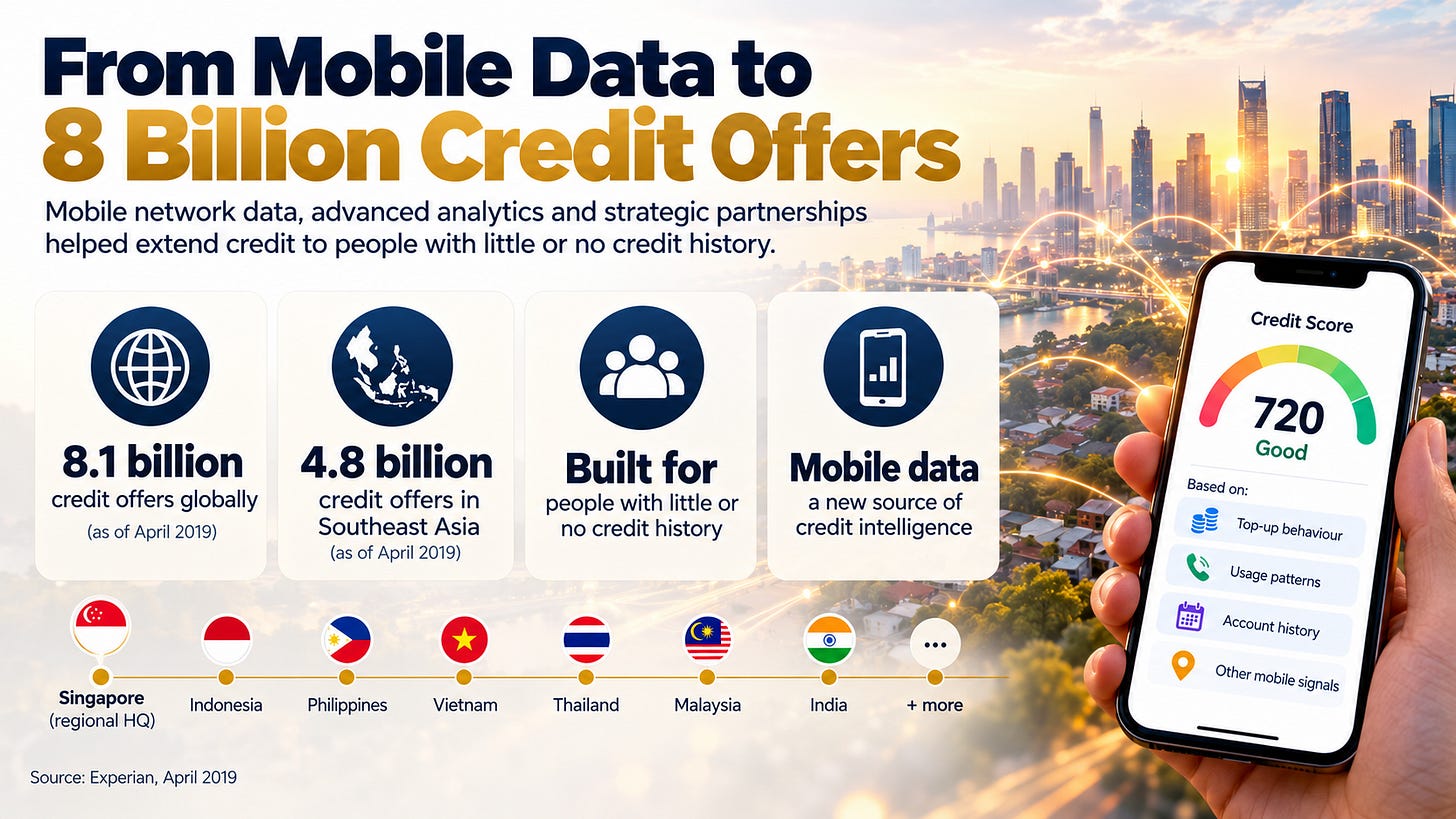
I joined a newly incubated business within Experian as the first employee on the ground in Asia, working directly with its CEO and a small team based in Monaco. By April 2019, Experian reported that the approach had powered 8.1 billion credit offers globally since 2010, more than 4.8 billion of them in Southeast Asia.
This is the story of the opportunity we saw, the model we built, the commercial problems we had to solve, and the lessons I still apply today.
The problem wasn’t creditworthiness. It was evidence.
Conventional credit scoring relies on a person’s existing financial relationships: credit accounts, repayment records, balances and previous borrowing. When that information isn’t there, lenders are effectively blind.
In many emerging markets, it wasn’t there. Some countries barely had credit bureaux. Where they did exist, coverage was thin and often skewed towards negative events such as defaults. A missing default record did not prove someone was a good borrower.
Consider a market trader who earns in cash, a vendor running a profitable stall, or a worker with irregular income and no employment contract. They may manage money responsibly, but without a bank account, payslips or borrowing history, a lender has nothing to assess.
What was missing was positive, predictive information. The GSMA highlighted this gap as early as 2012. Our opportunity was to create a new source of evidence rather than wait for conventional credit histories to develop.
The unexpected asset: the mobile phone
The insight was hiding in plain sight. People were generating behavioural data long before they generated credit data.
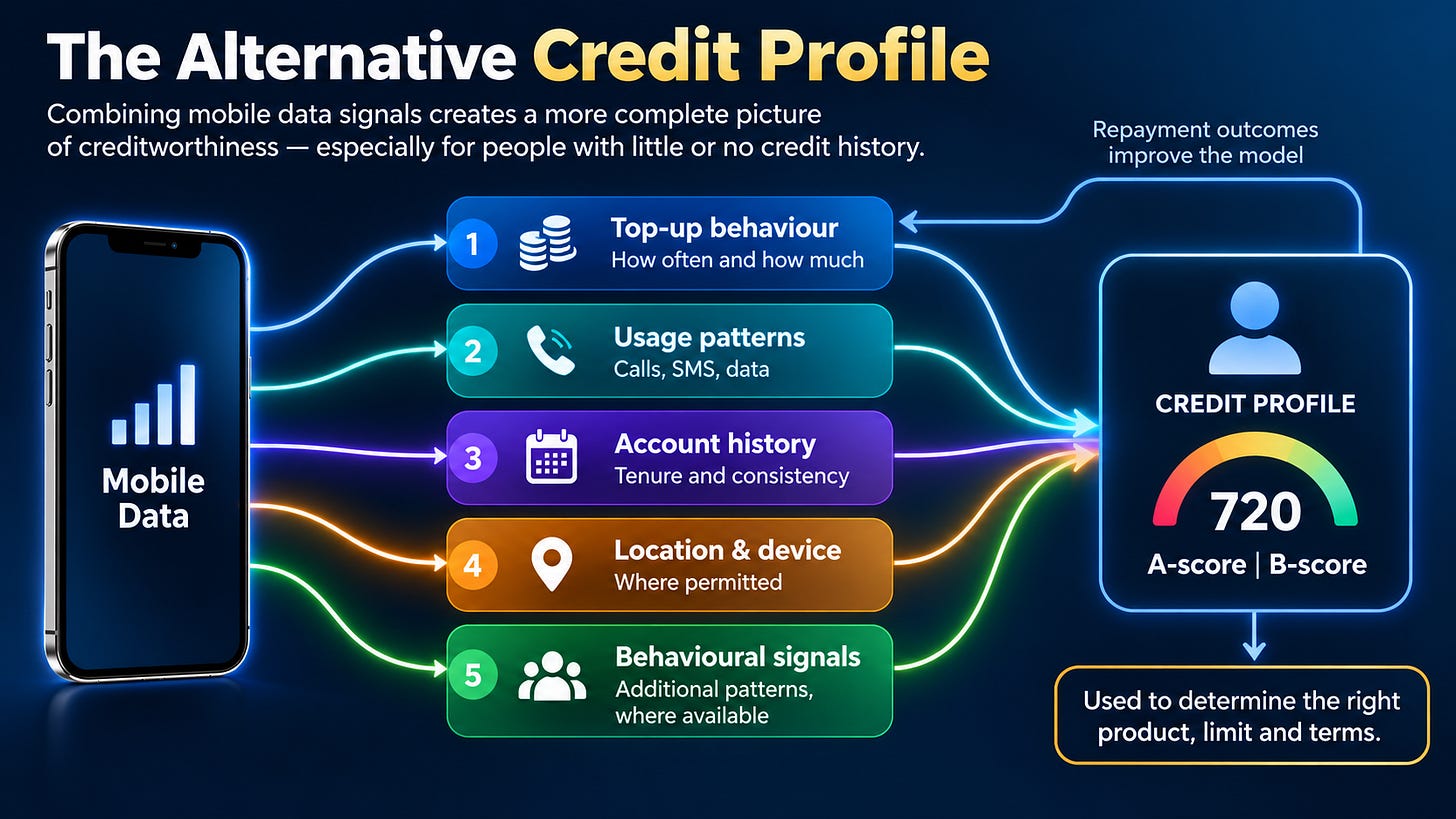
In prepaid-dominated markets, mobile operators held daily relationships with millions of customers who had never dealt with a bank. Depending on the market and what was permitted, that data could include:
Top-up patterns: how often and how much customers topped up.
Usage behaviour: voice, SMS and mobile data consumption.
Account history: tenure and service continuity.
Other signals: where lawful and available, device and location patterns.
No single signal proved anyone was creditworthy. Alternative data does not magically reveal ability to repay. It gives you new hypotheses to test when conventional data is missing. The work was finding which combinations, analysed at scale and tested against real outcomes, actually predicted risk.
Operators brought the customer relationship, distribution and data. Experian brought credit risk expertise and analytics. Connecting the two created a new route into financial services.
Start with a dollar: Dynamic Airtime Advance
The first product was Dynamic Airtime Advance (DAA).
A prepaid customer runs out of airtime when they need to make a call. Instead of having to find a top-up shop, an eligible customer receives a small advance, perhaps the equivalent of a dollar, for a fee. The advance and fee are recovered automatically at the next top-up.
The customer stays connected. The operator earns new revenue and strengthens the relationship. Fees and limits had to be transparent and proportionate: a product built for people new to credit only works if it doesn’t trap them in debt.
For us, the product had a second purpose. It let us observe real repayment behaviour. Did the customer repay? How quickly? How often did they use the service? That created a feedback loop:
Mobile behaviour → initial risk assessment → small advance → observed repayment → better risk assessment.
This is where dynamic mattered. A customer’s profile was not a static label. As evidence accumulated, their assessment and offers could change. The small advance was never the end goal. It was the entry point.
From scores to individualised offers
Credit risk teams use two familiar tools. An A-score (application score) assesses risk at the point of application. A B-score (behavioural score) refines that assessment using behaviour observed over time.
Our challenge was making both work with little or no bureau data. Mobile usage provided the initial signals. Airtime advances generated the repayment outcomes that tested and improved them.
That let us move beyond treating everyone in a broad risk band the same way. Using segmentation and machine-learning techniques, the question shifted from should this person get credit? to how much, on what terms, and when?
The longer-term prize was a pathway. With a strong track record, a customer could progress to:
Larger airtime advances
A postpaid mobile account
Small cash loans or overdraft-style products
Mainstream products such as credit cards, through financial-services partners
Each step needed its own risk and affordability assessment, and none was guaranteed. But the principle was powerful: a financial identity could be built over time, rather than determined by the history someone already had.
The model aligned four parties:
Mobile operator: customer relationship, distribution and data.
Analytics business: scoring, decisioning and risk management.
Funding partner: lending capital, with a share of the economics.
Customer: a useful service and a route to broader financial products.
This was embedded finance before most people used the term. And the same capability could extend into mainstream credit, for example more efficient customer acquisition for card issuers.
Building the business from Singapore
The technology was only half the story. The other half was building a commercial operation across very different markets.
At the start, I was effectively a one-person operation in Asia. There was no local team, no pipeline and no guarantee that operators would embrace an unfamiliar proposition. We weren’t selling a bureau product to banks. We were asking mobile operators to see their own customer data as the foundation of a new business.
That meant building a market, not just selling a product.
Indonesia was the first launch market, with near-universal prepaid usage and a large thin-file population. I closed a first-of-its-kind deal there with one of Indonesia’s leading mobile operators, working directly with operator and mobile-wallet leadership at C-level. From that reference point, we expanded across the Philippines, Malaysia, Thailand, Vietnam and Myanmar, and into India, Sri Lanka, Nepal and Bangladesh.
Singapore was the right base. Its connectivity made it practical to reach senior decision-makers across the region without a full team in every country.
The approach was simple: land, prove, expand. Win the first customer, make it referenceable, adapt to each market, and use that evidence to open the next conversation. Expansion into a new region doesn’t always need a large upfront investment. A capable person on the ground, a focused first market and strong relationships can lay the foundation. Investment can then follow traction.
Four hard lessons
Building a new category rarely follows the original plan. Four lessons have stayed with me.
1. Start small, prove the model, then scale
We were asking the market to trust a new way of assessing credit risk. That trust had to be earned with outcomes, not demos. Credit models only prove themselves over time, against real repayments, market by market.
Small airtime advances let us measure performance and refine the models before testing larger amounts. When you are creating a category, don’t try to prove the whole vision on day one. Find the smallest commercially viable product that generates the evidence you need.
2. Your business model is a hypothesis, not a plan
As the opportunity became clear, operators’ expectations changed. They wanted more skin in the game, a partnership rather than a vendor relationship, minimal upfront capex and a bigger share of revenue.
We redesigned the commercial model several times while protecting the underlying economics. The product may be right while the deal structure is wrong. When the economics become meaningful, every partner wants a different share of the upside.
3. Owning the data is not the same as owning the capability
As the business became profitable, one partner decided to replicate it in-house on a subset of customers. The results were disappointing and the economics didn’t work.
The value of a credit analytics business goes well beyond raw data or an algorithm. It sits in model development, segmentation, continuous testing, risk optimisation and the operational discipline to run it all. Sometimes the cheapest-looking option is not the most profitable one.
4. Great analytics still needs capital
A model doesn’t fund a loan. One of our biggest early obstacles was finding a balance sheet willing to lend to customers with no conventional credit history.
I had to source third-party funding partners myself, and the initial cost of funding was high. As performance data accumulated, the risk became easier to price and our funding costs came down. Better analytics didn’t just improve credit decisions. It made the business fundable.
Product-market fit is only one part of the equation. You also need a funding model, a route to market and unit economics that improve with scale.
From one market to billions of credit offers
Experian’s published figures show the scale the model reached:
June 2018: more than 5 billion credit offers since 2010 across Asia, Latin America, Africa and beyond, over 2 billion of them in 2017 alone.
April 2019: 8.1 billion globally, more than 4.8 billion in Southeast Asia through Dynamic Airtime Advance, and over 300 million offers a month.
These are credit offers, not completed loans or repayments. But they show this was a substantial commercial operation, not an experiment, and that Southeast Asia was at its centre.
The model also showed what embedded credit can do beyond commerce. Experian reported that after a natural disaster in one Southeast Asian market, the operator used DAA to offer emergency advances to all subscribers for three days, regardless of eligibility.
The broader idea has since become mainstream. Lenders now draw on bank transactions, payment histories and merchant cash flows, and products such as M-Shwari in Kenya combined mobile money with behavioural data to offer savings and credit. The question is no longer whether alternative data exists. It is whether it is validated, lawful, fair and used to offer credit people can afford.
Sidebar: when your credit score goes on your dating profile
Alternative data has taken some unexpected turns.
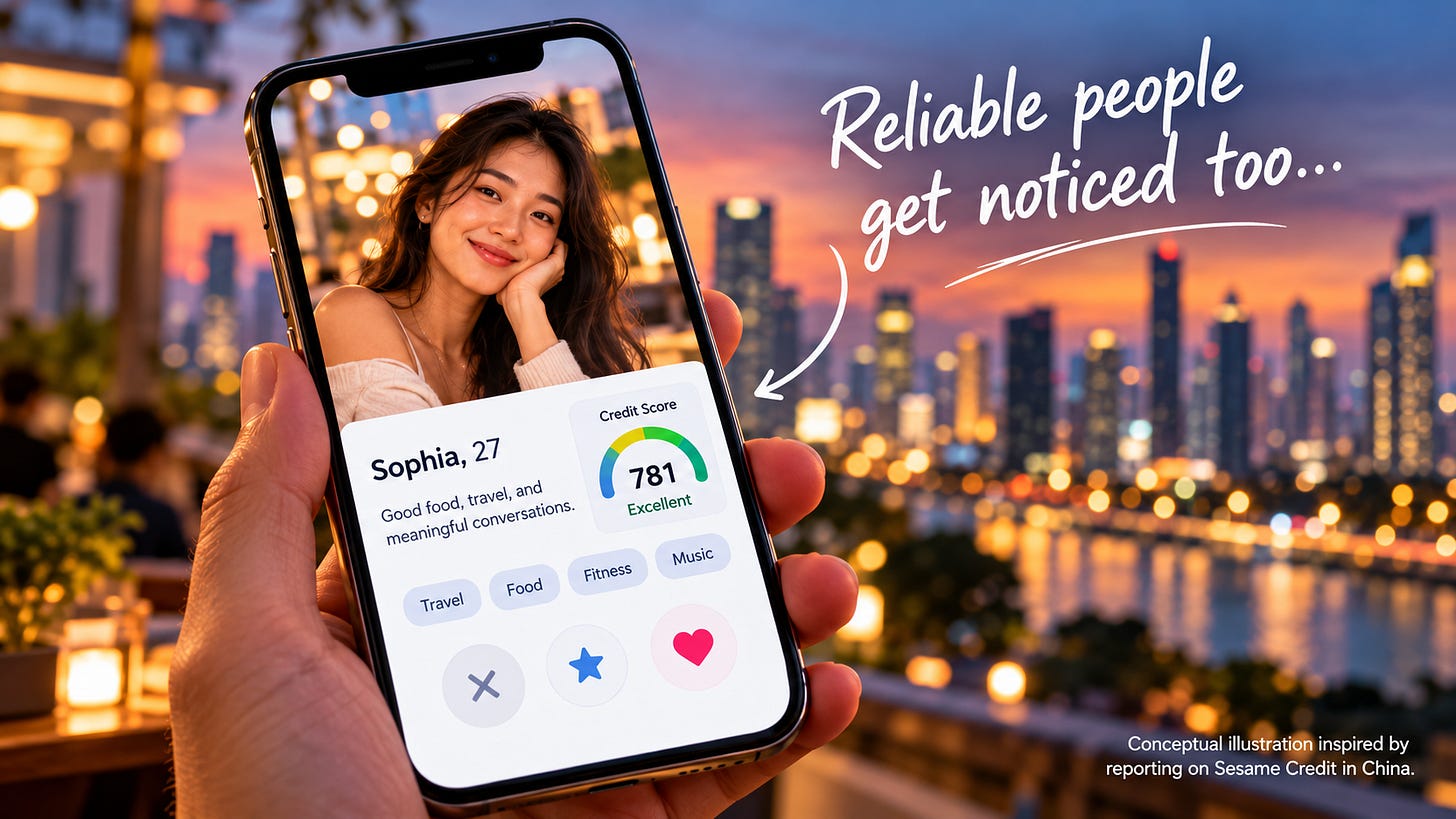
China’s Sesame Credit, a commercial scoring service from Alibaba’s Ant Financial, drew on shopping, payments and other behaviour to rate users. The story that went viral: matchmaking platform Baihe encouraged users to display their Sesame Credit scores on their dating profiles. A financial score became a signal that you were a good catch.
“Pays bills on time” takes on a whole new meaning.
Two caveats. Sesame Credit was a private commercial score, not the single government “social credit” score it is often confused with. And it illustrates the line credit providers shouldn’t cross. In lending, the question is narrow: what evidence helps assess whether this person can repay this product? That is very different from reducing a person’s trustworthiness to one number.
More data is not automatically better data. The signals that matter are the ones that are relevant, validated and used with proper regard for privacy and fairness.
The next chapter: stablecoins have a distribution problem
The biggest lesson from Experian wasn’t about algorithms. It was about distribution.
The technology made the product possible. The operator’s existing relationship made it scale. Customers didn’t download a new app or open an account. The service appeared inside something they already used every day.
I see the same dynamic in stablecoins today. The technology problem is largely solved. The distribution problem is not. Issuance, wallets, settlement and compliance tooling are increasingly available off the shelf. What is scarce is a trusted channel to the people who would benefit most.
Mobile operators may be the largest untapped channel. In emerging markets they already have:
Millions of KYC’d subscribers and a trusted everyday brand
Mobile-money and, in some markets, cross-border licences
Agent networks that act as cash-in and cash-out rails
Behavioural data that can underpin credit, exactly as it did at Experian
I tested this thesis directly. With a stablecoin startup I founded, we piloted a stablecoin product with a mobile operator in Africa, applying the playbook I learned at Experian. The demand signals were clear: people wanted dollars to save in, the ability to receive dollars from overseas, and access to dollar-denominated credit. Operators saw a new product and a new revenue stream.
The parallels are direct:
Start with a simple, useful product, as airtime advance did, then build towards savings, remittances and credit.
Align the economics. Operators will want revenue share and skin in the game, not a vendor relationship.
Treat trust as part of the product. Customers think about whether the service solves a problem and whether they trust it, not about the blockchain underneath.
The companies that win in stablecoins won’t necessarily have the best technology. They will be the ones that combine it with distribution, trust and disciplined execution. I’ll go deeper on the MNO stablecoin model in my next article.
Final thought
The Sesame Credit story is funny because it took a financial score and made it personal. The more important story is what happens when people have no score at all.
For millions of people, having no credit history was never proof they were unreliable. The system simply had nothing to judge them on. By using alternative data responsibly, we created another route into the financial system, starting with something as ordinary as topping up a phone.
The real opportunity is not just to build something new. It is to make something valuable accessible to people who couldn’t access it before.
TL;DR
Alternative data opens new markets. Mobile usage gave lenders useful signals on people with no credit history.
Start small and prove it. Real repayment outcomes mattered more than theoretical promise.
Data isn’t the moat. Models, testing and operational discipline created the value.
Commercial execution matters as much as technology. Revenue-share partnerships and third-party funding made it work.
Distribution creates scale. Operators’ existing relationships turned a $1 product into billions of credit offers. Stablecoins now face the same test, and mobile operators may be their biggest untapped channel.
Further reading
Experian: 4.8 billion credit offers in Southeast Asia (April 2019)
Experian: MicroAnalytics and mobile network operators (June 2018)
GSMA: Mobile records and credit scoring, regulatory considerations
Jason Fullam is a digital assets and payments professional based in Singapore. More at jasonfullam.com.
Also published on Substack.

Digital assets & payments · Singapore