The home is the largest asset most households will ever own, and one of the hardest to put to work.
For most people the story is familiar. You buy a home, build equity over 10, 15 or 20 years, and watch its value rise. But when you want to access that value, the clock resets. A new application. A new valuation. New legal checks. New paperwork. Weeks, sometimes months, before the capital is available.
That is about to change.
I believe all real estate will eventually be tokenized, and sooner than most people in finance and property expect.
Not because anyone needs another way to buy and sell houses. And not because every home has to become a tradable digital asset. The real opportunity is more practical: turning the equity locked inside real estate into programmable financial value that can be accessed in minutes rather than months.
Imagine a mortgage that already knows who owns the property, what it is worth, how much is outstanding and what the lending limits are. When those conditions are met, borrowing against the equity in your home does not mean starting the process again. The rules simply execute.
That is the mortgage of the future.
I know because I have seen a version of it work. When I ran the Hong Kong mortgage pilot at Ripple, with a commercial bank and the central bank, we hit a hard limit: the land registry could not be tokenized. So we tokenized the mortgage instead. A loan secured over a property could be released, drawn on and repaid by rules rather than by paperwork. That workaround was my first glimpse of what happens when a mortgage stops being a static product and becomes programmable infrastructure.
Since then, Dubai and Saudi Arabia have begun putting property title itself onto digital infrastructure. Hong Kong tested the loan layer. The Gulf is building the title layer. Put the two together and you get a mortgage that can respond to the value of the asset behind it, so homeowners can draw on growing equity without rebuilding the same financing process each time.
I also believe these mortgages will still be issued by traditional banks. The digital asset technology will be built into their products, or supplied to them by digital asset specialists as a finished stack. This is a story about banks modernizing their core product, not about banks being bypassed.
Here is what it changes, and for whom:
Homeowners can draw on their equity quickly and at lower cost, without selling the home.
Banks gain a new velocity of lending: more loans against collateral they already hold, originated faster and at lower cost.
Regulators get a new asset class, tokenized mortgages, created in a safe and transparent way, with real-time visibility into it.
Governments see released equity flow back into the economy as spending and investment, which supports GDP growth.
Brokers spend less time chasing paperwork and more on advice and structuring.
Digital asset firms have a clear job: deliver the integrated stack that lets a bank offer it.
In this article: why today’s system is so slow, what we built in Hong Kong, what the Gulf is building, what a connected mortgage looks like, who has to build it, and what could go wrong.
Why a mortgage still takes weeks
A mortgage takes weeks because ownership, identity, value and debt are each recorded in a different place, and every party rechecks the others’ records by hand.
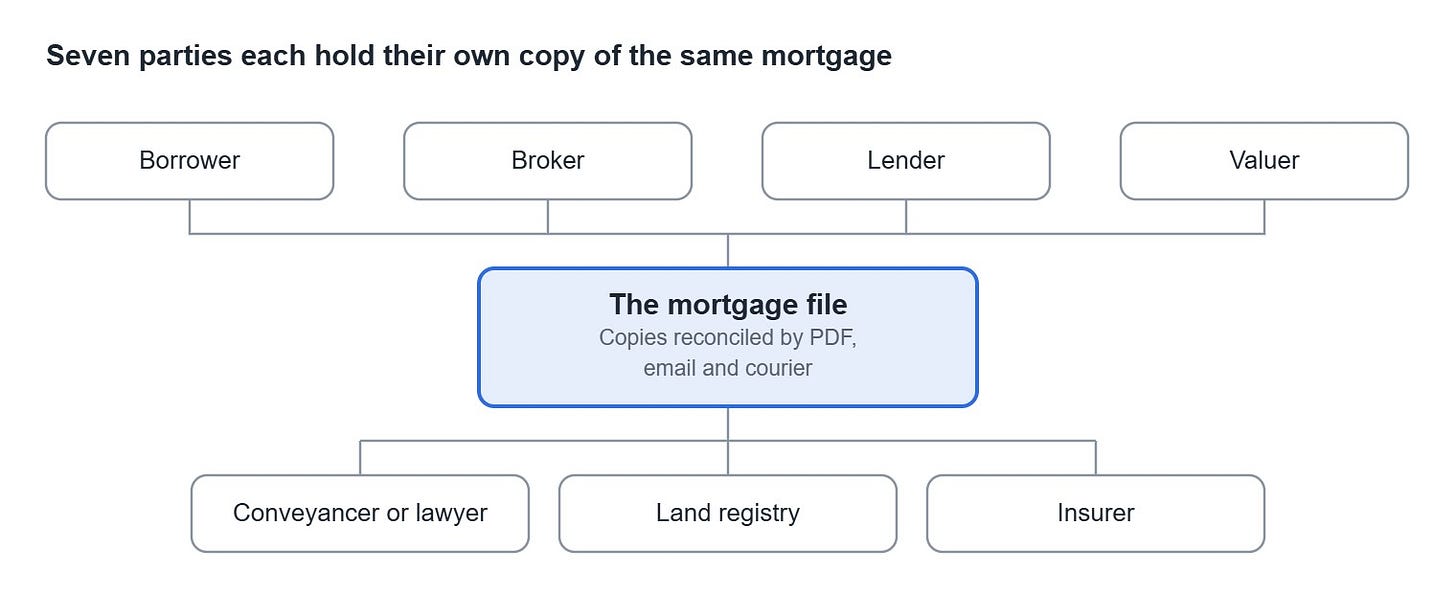
A typical origination involves the borrower, a broker, the lender, a valuer, a conveyancer or lawyer, the land registry and an insurer. Each holds its own copy of the facts. The copies are reconciled by PDF, email and courier, and every handoff adds delay and a chance for error. Every handoff is a delay, and every copy is a chance for the records to disagree.
Title checking shows the problem clearly. In Hong Kong, as Reuters described the starting point, the bank collects title information from the customer and then checks it against a separate title deed register. The pilot aimed to halve a loan approval process that takes about a month, in a mortgage market of HK$1.8 trillion (about US$229 billion).
I am from the UK and have bought and sold many properties there. It is a mess. In one UK house sale used to test a blockchain prototype, the law firm involved reported that the conveyance took 22 weeks against an initial estimate of six.
The cost shows up in three places:
Time: weeks to close a loan, and weeks again to remortgage.
Money: duplicated fees and manual checks at every step.
Locked equity: the value a home has gained is hard to use, so most owners never touch it.
Brokers exist in large part to absorb this friction. They chase documents, translate between institutions and keep the file moving. If the friction falls, the broker’s job moves from paperwork to advice and structuring.
The bottleneck nobody prices in: conveyancing
Conveyancing is the part of the process I find hardest to defend. Every time the same property is sold, solicitors are instructed again and the same searches are ordered again, on a home whose records have barely changed. We pay professionals, again, to repeat the checks.
In England and Wales a typical purchase includes local authority searches, plus drainage and environmental searches. Local authority searches typically cost £250 to £450, and conveyancing fees for a purchase run from about £400 to £1,500 before disbursements, according to the HomeOwners Alliance. The searches themselves usually take around 10 working days, and three to five weeks in busier areas. The UK government says the average purchase takes about 120 days from accepted offer to completion, up 60% since 2007, and that one in three sales falls through. A remortgage can bring much of the same legal work back again.
Once the title and deeds sit on a ledger and have been verified, the next buyer or lender starts from a verified record instead of from scratch. The searches and legal checks that repeat on every transaction become lookups. I think this is where homeowners would feel the saving first, because it applies to every purchase, sale and remortgage, not just the first.
The government is already trying to cut about four weeks from the process. A ledger-based record attacks the repetition itself.
Three levels of property tokenization
Tokenizing property means three different things, and the level you choose decides which problem you solve. A token here is a digital record of a legal right, held on a shared ledger instead of in one institution’s database.
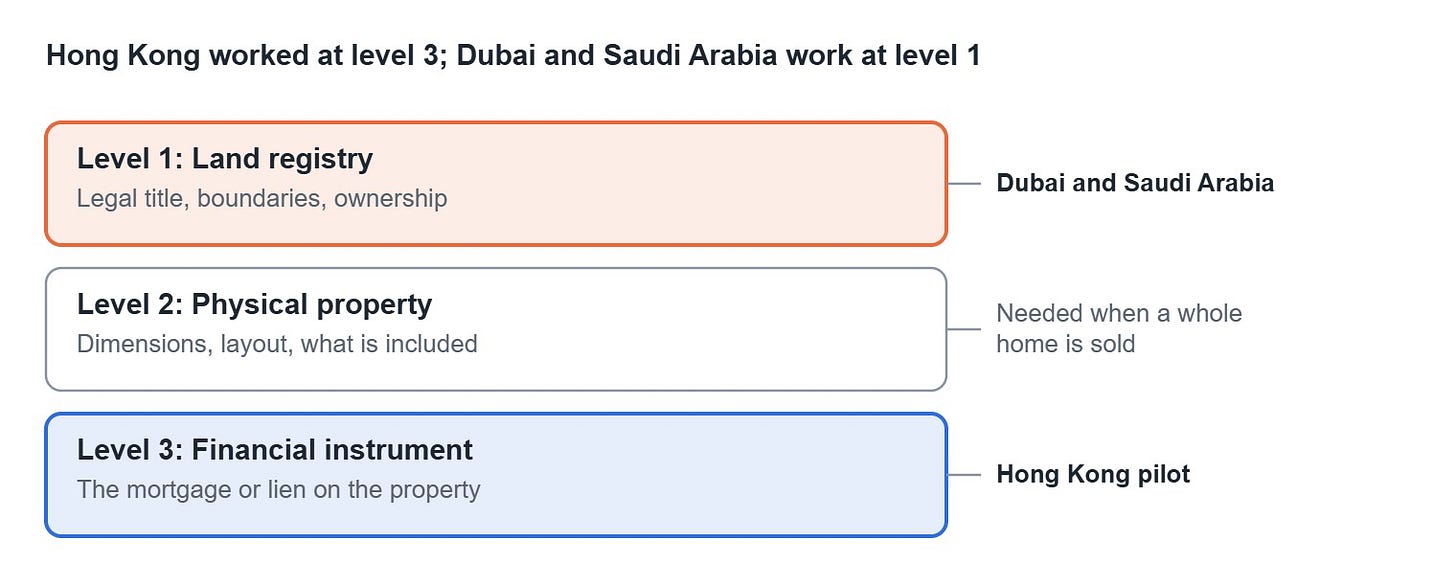
Level 3 matters when someone borrows against a home they already own. Levels 1 and 2 matter when ownership changes hands.
Tokenizing a real-world asset is as much a legal engineering problem as a technical one. The token has to map to a legal right that a court will enforce, which is why the legal design of the smart contract matters as much as the blockchain underneath it.
What we built in Hong Kong
The pilot was part of the Hong Kong Monetary Authority (HKMA)’s e-HKD programme, and it was public. Reuters reported the plan in June 2023: Ripple and Fubon Bank (Hong Kong) were the two participants examining the digital currency in residential mortgages, a segment that made up about a fifth of the banking sector’s loan book. That is the project I ran at Ripple.
The Reuters description is the proof point for everything in this article. When loan-to-value and property value conditions are met on the bank’s digital platform, the loan is released automatically, because the title is already secured on the blockchain. The stated aim was to halve a month-long approval process. Ripple said it expected the approach to remove much of the work lawyers do today, and Fubon said it expected to use it for new loans and for top-ups of existing mortgages.
Reuters described the plan in terms of title deeds. In practice we could not tokenize the land registry, so we tokenized the mortgage itself: the loan and the lien over the property. That limit is where the idea of the mortgage of the future began. If the registry could not move onto a ledger, we could still put the mortgage there, and it showed what the whole system would look like once the title followed.
In Hong Kong we tokenized the loan, not the title. The land registry was not available on a ledger, and no sale was taking place, so we worked at level 3.
The product was an equity release: a second loan against a property the homeowner already owned, in the style of a home equity line of credit. The owner borrows against the home without selling or moving. The bank provides the cash as a tokenized deposit or as central bank digital currency, structured as a loan secured over the house. That mortgage is tokenized and held as collateral, so the property cannot be sold without repaying the loan first. The owner receives a lump sum into a bank-issued wallet and can repay flexibly, at any time, rather than on a fixed schedule.
The stack had four parts:
A tokenization engine with the legal terms of the loan built into smart contracts.
A lending protocol that locks the tokenized loan in as collateral and manages loan-to-value limits and repayments automatically.
The XRP Ledger as the settlement layer, with an Ethereum-compatible side chain for the contract logic.
The bank’s own custody, wallet and on- and off-ramp infrastructure, white-labeled under its brand.
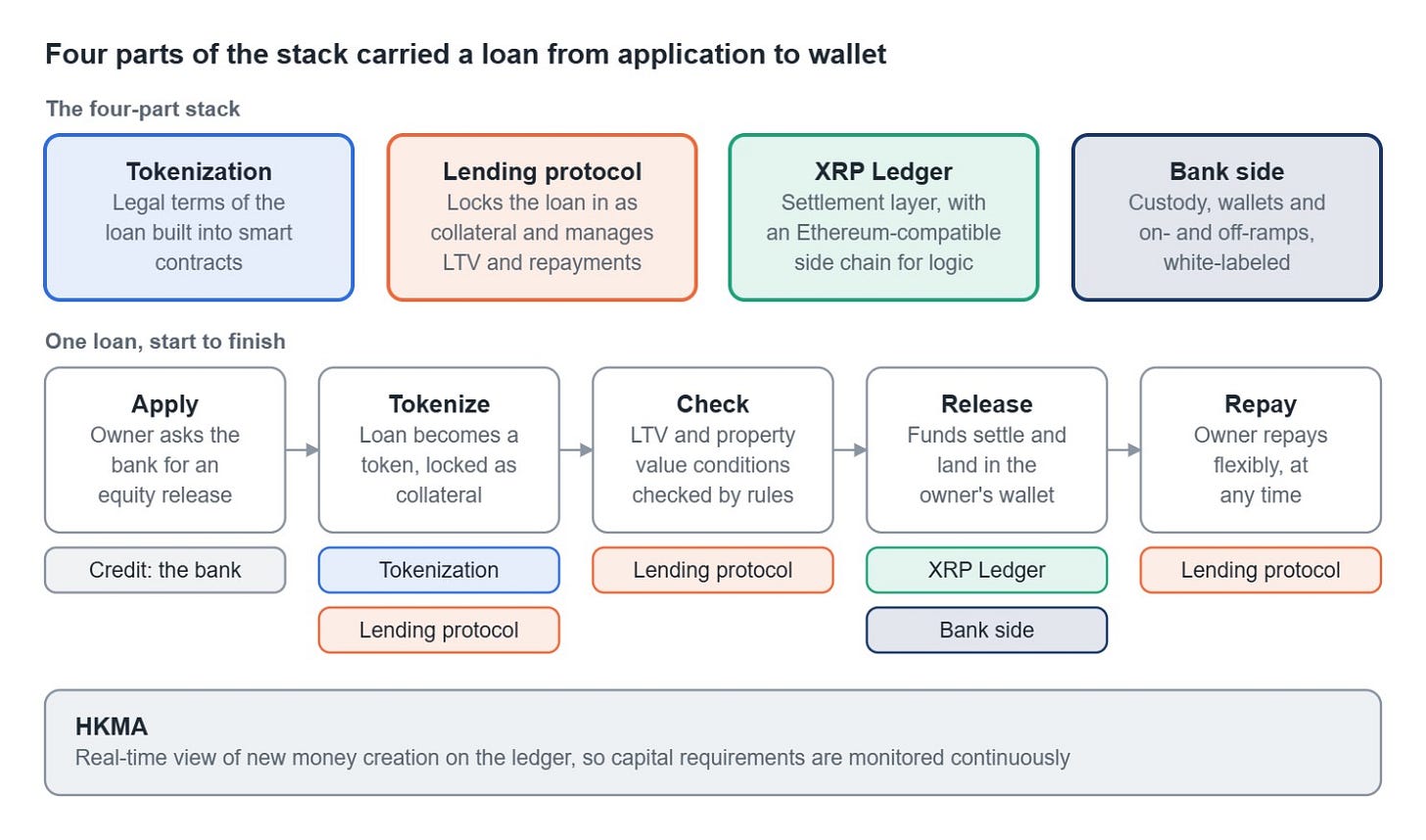
The regulator got real-time visibility into new money creation on the ledger, so capital requirements could be monitored continuously rather than reported afterwards. The bank kept all of the credit risk. Our protection was the collateral structure: if a borrower defaults, the house is sold and the loan recovered from the proceeds.
The public target was to halve a month-long approval. The design ambition was faster still: minutes rather than weeks.
The reception was split. Some banks pushed hard to adopt it quickly. More traditional banks did not understand the model and did not engage. That was the clearest evidence I saw that adoption is limited by organizational understanding, not technology.
Since the pilot, HKMA completed the second phase of its e-HKD programme in October 2025 and named wholesale use its immediate priority. The lesson I took from our pilot is narrower: tokenizing the loan works, but the title still lives in the old system, which caps how much of the process can be automated.
Three lessons stayed with me. The loan layer can become programmable even when the title layer cannot. The regulator gains as much visibility as the bank gains speed. And the technology was never the hardest part. Getting an institution to understand it was.
This has been tried before
The UK ran one of the earliest government-backed attempts. HM Land Registry’s Digital Street research programme, which began in 2017, built a blockchain prototype with Mishcon de Reya LLP, MyHomeMove, Shieldpay, Yoti and others, and tested it on a real house sale in Gillingham, Kent. Mishcon de Reya reported that the conventional sale had taken 22 weeks against an estimate of six, and that the prototype completed the transfer in just under 10 minutes.
As far as I can tell, it never moved beyond the pilot. At the time HM Land Registry said it did not plan to adopt blockchain itself any time soon, and it put its effort into digitising existing services such as the digital mortgage deed. I have not found a published explanation. My own read is that a registry has little reason to lead a market on its own, and that the pull has to come from the people who lend against property.
It was not alone. Georgia’s national registry began recording land transactions with a blockchain-anchored system in 2016, and reported about 100,000 titles registered under the programme. Sweden’s land registry ran a proof of concept in 2016 and then a blockchain testbed. A project in Honduras was reported to have stalled.
Most of these efforts went after the registry or the transfer, not the lending. What is different now is that the money side is catching up. Central banks, including the HKMA, are testing tokenized deposits and digital currency, which is the settlement leg these early pilots lacked.
Dubai and Saudi Arabia start with the land registry
Dubai and Saudi Arabia are working on level 1, the title itself, and both are doing it with the registry at the center.
Dubai. The Dubai Land Department, working with its virtual assets regulator, the central bank and the Dubai Future Foundation, has begun tokenizing title deeds on a licensed platform. The first project sold within a day of its May 2025 launch. In February 2026 the department opened controlled resale of those tokens in a secondary market. It projects tokenization could reach about 7% of Dubai’s transactions by 2033. That is a projection, not a result.
Saudi Arabia. The Real Estate General Authority and the national registry have built a sovereign blockchain infrastructure for property, with the registry ledger as the definitive record of ownership. The first tokenized title deed has been traded.
The two approaches differ in structure. Dubai runs a licensed platform model on a public ledger. Saudi Arabia runs a top-down model on infrastructure the registry itself operates. Both lead with fractional ownership and liquidity for investors.
In the reporting I have seen, both are focused on investor access, liquidity and trading, not on lending against the tokenized title. That gap is the argument of this article. Hong Kong built the loan layer without the title. The Gulf is building the title layer without the loan.
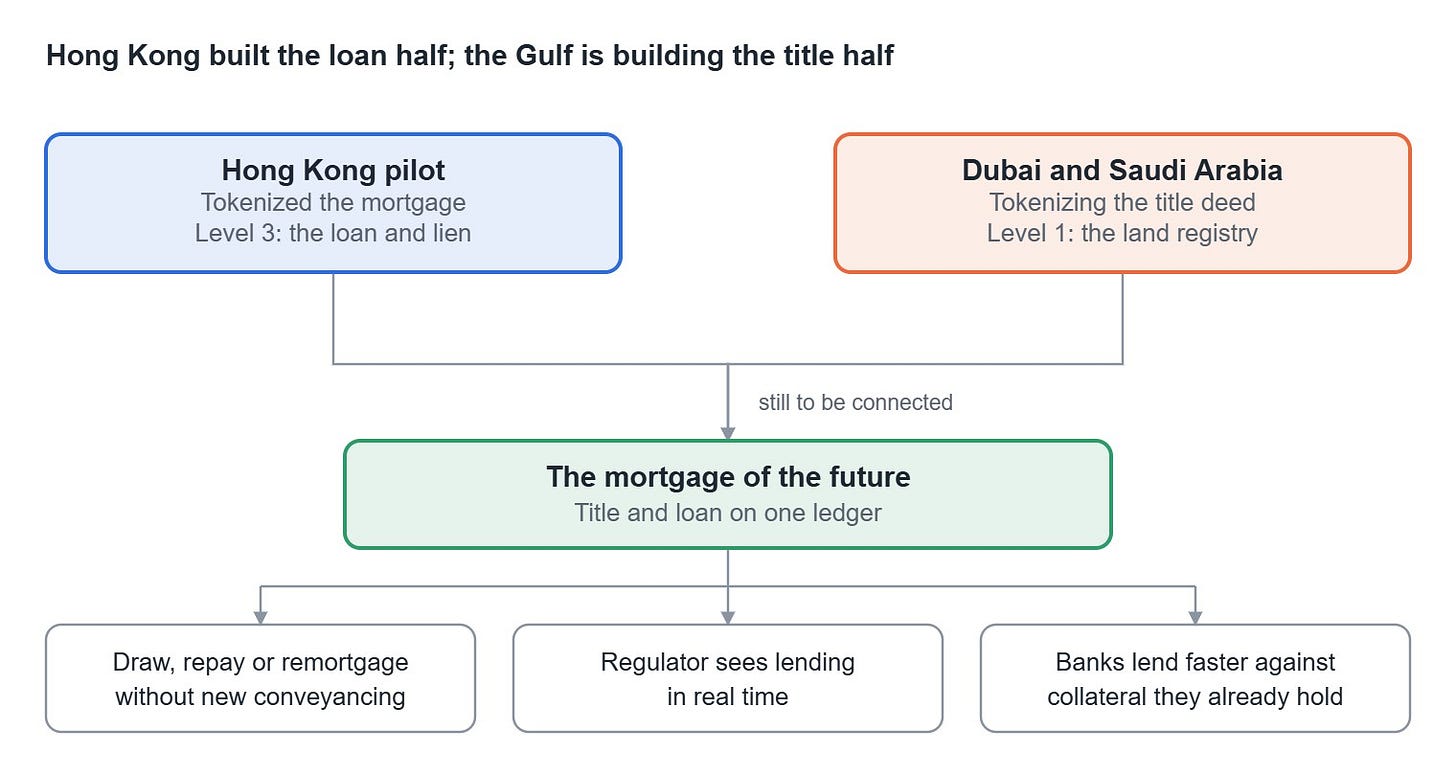
Each half works on its own. The real outcomes appear only when the two are joined: you can draw, repay or remortgage without new conveyancing, the regulator sees lending in real time, and banks lend faster against collateral they already hold.
How a programmable mortgage works
A programmable mortgage turns the slow steps into rules that run automatically. Once the title and the loan sit on the same ledger, the checks that take weeks today become lookups.
Title check: today you collect documents and check a separate registry. In a programmable mortgage, the title is read on the ledger.
Valuation: today an appointed valuer produces a manual report. In a programmable mortgage, a live valuation feed does the job.
Lending limits: today an underwriter reviews them. In a programmable mortgage, loan-to-value rules are written into the contract.
Origination: today it takes weeks. In a programmable mortgage, the lending decision executes in seconds once title, value and identity are verified.
Extra borrowing: today it needs a new application and new conveyancing. In a programmable mortgage, you draw in increments within the limit.
Repayment and remortgage: today it follows a fixed schedule, with new paperwork to move. In a programmable mortgage, you repay, redraw or remortgage at any time without new conveyancing.
Not every step becomes instant. Valuation, underwriting and legal enforcement still take the time they take. What changes is that once title, value and identity have been verified, the lending decision itself can execute in seconds. The pilot tested the loan-to-value and repayment logic. A reliable live valuation feed is the next dependency, because the lending limit is only as good as the number it is checked against.
As long as the borrower stays inside the agreed limits, no one has to approve each step. The rules approve it.
A hypothetical journey: buying a home with the mortgage of the future
This is a scenario, not a description of any live system. I have used the UK because I know it best.
Offer and application. You put an offer in on a home sold at market rate through an estate agent, and apply for a mortgage at the same moment.
Your data, on your terms. Your credit history and latest earnings information are already digitised and protected on chain using zero-knowledge proofs. You give the bank permission to see the data it needs, and it can verify the facts without you uploading payslips or statements. This takes seconds.
Less duplication on the property. The home’s structure was audited three years ago and the audit sits on its record, so in many cases the surveyor visit is not needed. The bank draws valuation data from online estate agents and market sources.
An instant decision. The bank reviews everything in seconds, with no human involved. A large loan or a high loan-to-value ratio can still go to manual sign-off.
Title and funds move together. Once approved, the title and deeds are tokenized under the bank’s own system, and the loan is issued as sterling digital money, such as a regulated stablecoin or a tokenized deposit, and paid instantly.
A live account. After completion you can see your home’s value, the cost of the mortgage and your outstanding balance in real time. You can pay down more or borrow more at any time, within the rules.
The diagram below sets this beside today’s process, using the UK government’s own figures for the current average.
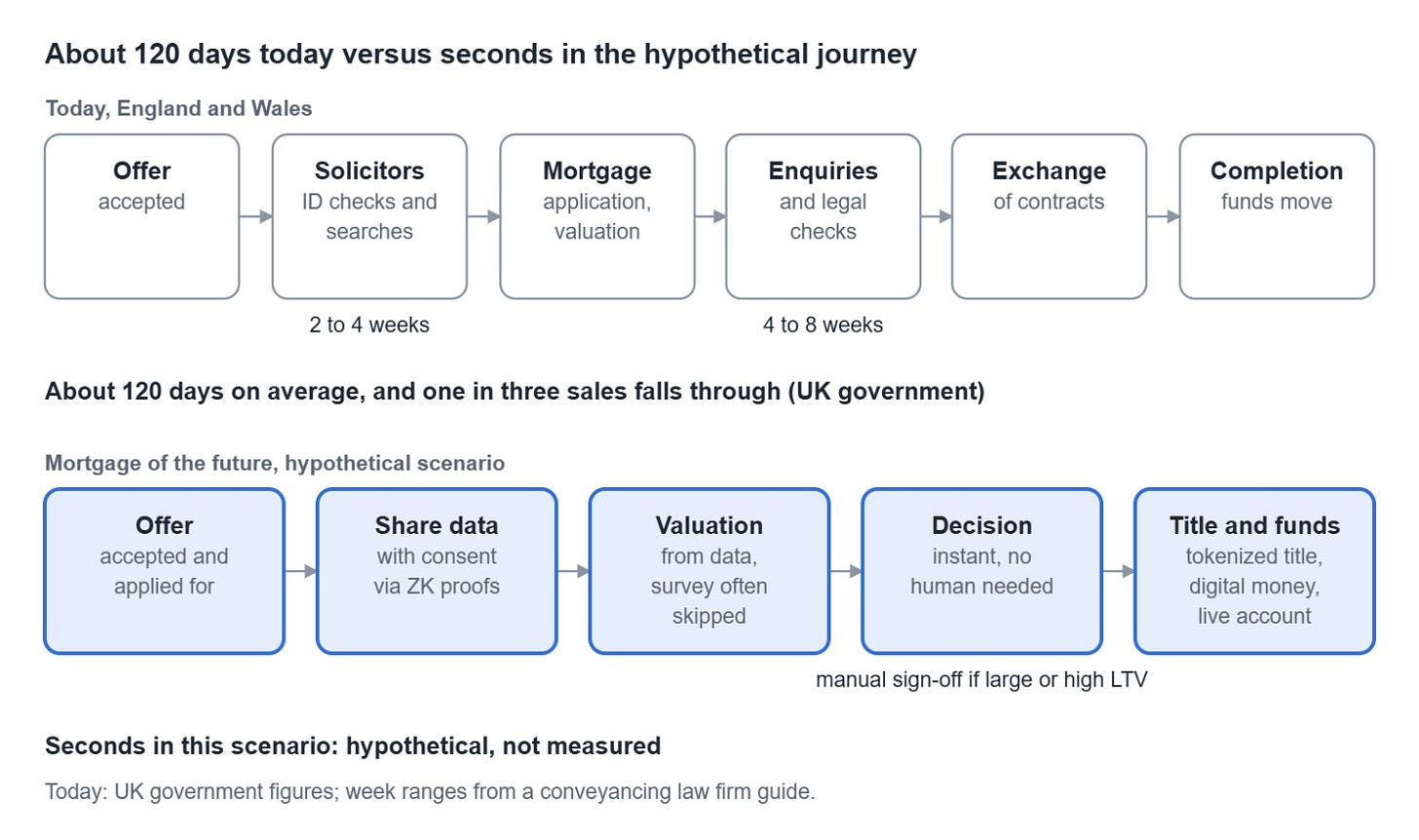
This only works if several things are true. Lenders must still meet affordability rules. The structural audit has to be trusted and kept current. Valuation data has to be reliable. The legal right behind each token has to be enforceable. And you must stay in control of who sees your data. The technology does not solve any of those on its own.
The second mortgage that matters is your equity
For most homeowners the first mortgage happens once. The product they use repeatedly, if it is easy enough, is borrowing against the equity that builds up over time.
Most people live in a home for 10 to 20 years. In many markets its value rises substantially over that period. Most owners never use that gain, because borrowing against it means a new application, a new valuation, new legal work and weeks of waiting. The equity sits idle.
In a programmable mortgage, the owner has already passed the checks. As the property value rises and the loan balance falls, the headroom under the loan-to-value limit grows, and the owner can draw additional funds from it in increments, repay them when they choose, and draw again. There is no new conveyancing and no new paperwork for each step. The product is the growing gap between what the owner owes and what the rules let them borrow: room to borrow that the owner did not have on day one.
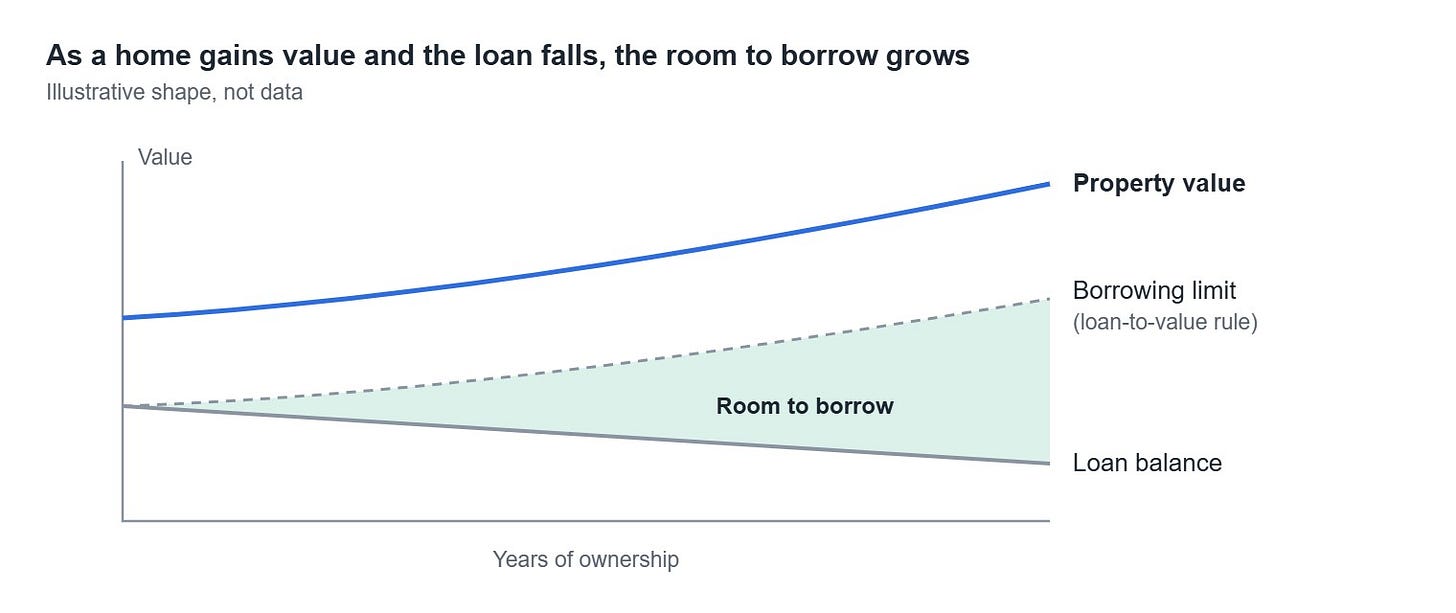
Take a simple case. You buy a home today. Some years later its value has risen well beyond what you paid. Your bank already knows the property’s value, your outstanding loan, the borrowing limit that applies and who you are. You ask for a further advance. The system checks the rules. If you are within them, the money is released. No new application. No new conveyancing. No weeks of paperwork.
The blockchain is not the product. The product is frictionless access to collateral.
For owners who want to use the value their home has gained, this is the product that matters, and it is the hardest one to use today.
Who benefits
Each party gains something different, and each gain depends on a condition.
Homeowners: quick access to equity without selling, and the ability to repay or remortgage at any time without new paperwork. Borrowing is not a sale, so it generally avoids the tax a sale can trigger. This depends on local tax rules, which vary by country.
Banks: more lending against collateral they already hold, at lower cost to originate and service. This depends on loan-to-value limits and valuation data staying reliable.
Lenders and financial institutions: a stronger security position, because the lien sits on the same ledger as the title, and a faster route to recover and sell a property if a loan goes bad. This depends on local enforcement law. The ledger removes document chasing, but courts still set the timeline.
Governments and regulators: real-time visibility into lending, and released equity that can fund household spending and support growth. The same mechanism can increase household leverage if limits are loose.
Brokers: less time on paperwork, more on advice and structuring. This depends on brokers moving up the value chain.
Investors: pools of tokenized mortgages to buy, sell or borrow against. This depends on the credit quality of the underlying loans.
The bigger prize is real estate on-chain
Tokenization so far has mostly covered treasury bills, money market funds and stablecoins. Real estate, the largest asset class most people ever own, has barely been touched.
Deloitte’s Center for Financial Services forecasts about US$4 trillion of tokenized real estate by 2035, up from under US$0.3 trillion in 2024. Its largest slice, about US$2.39 trillion, is tokenized loans and securitizations: the mortgage-backed layer. It is a forecast, not a result.
Once mortgages are tokenized, they can be pooled into mortgage-backed securities that live on-chain. That creates a new asset class that investors can buy, sell and borrow against, and it gives lenders another way to fund new loans.
Securitization already exists, so the claim needs to be precise. What changes is transparency, shared data and the cost of servicing. Investors can see the loans behind a pool in real time, and payments can be routed automatically. The credit risk of the underlying borrowers does not change.
Who builds it: banks need a finished stack
My view is that the mortgage of the future will be issued by traditional banks, with digital asset know-how built into the product underneath. That know-how can reach a bank in two ways: the bank builds it internally, or a digital asset specialist delivers it as a service. My guess is that most banks will take the second route.
Any digital asset firm that can assemble the pieces could offer this. Ripple is one example, used here only as an illustration: it now has the ledger, custody, security, wallets and a stablecoin under one roof, which covers much of what a commercial bank would need, packaged as one integrated solution.
Most banks cannot deliver this on their own, and in my experience they should not be expected to. Core banking systems were not built for tokenization, on-chain custody or smart-contract lending, and a bank’s procurement and risk processes are not built to assemble half a dozen new components from different vendors.
That puts the job with digital asset firms. The most useful thing they can bring a bank is not a ledger or a token. It is a finished, integrated stack, and an offer that says: this is the end-to-end technology for the mortgage of the future, and we want to build it with you.
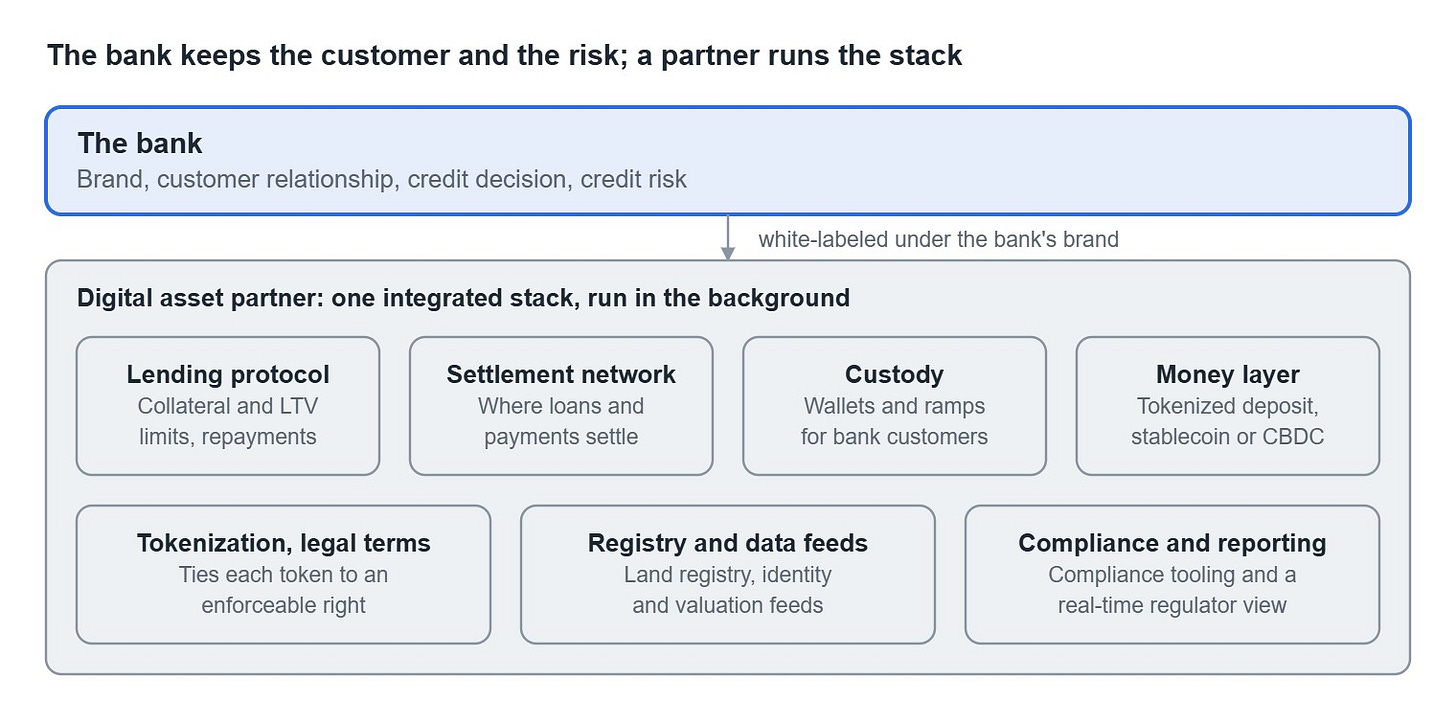
A complete offer covers:
Tokenization and the legal engineering that ties each token to an enforceable right.
A lending protocol that manages collateral, loan-to-value limits and repayments.
A settlement network.
Custody, wallets and on- and off-ramps for the bank’s customers.
The money layer: tokenized deposits, a stablecoin or central bank digital currency.
Integration with the land registry, plus identity and valuation feeds.
Compliance tooling and a real-time reporting view for the regulator.
In Hong Kong the stack was white-labeled under the bank’s brand. The bank kept the customer relationship, the credit decision and the credit risk. The technology partner ran the stack in the background, and the two shared the economics of the new lending. I think that is the right shape for most banks. The bank owns everything the customer sees and every credit decision. The partner owns everything underneath.
Banks have their own part to play:
Start with one narrow product, such as an equity-release loan, rather than a full platform.
Bring risk, legal and compliance in from the first week. In Hong Kong the banks that held back did so for lack of understanding, not because the technology failed.
Name an executive sponsor who owns the outcome.
The digital asset firms most likely to get banks to move are the ones that treat this as an integration problem, not a technology showcase.
What can go wrong
The technology is the easier part. These are the risks that decide whether it works at scale:
Over-leverage. If drawing equity is quick and cheap, households can borrow more, more often. Limits have to be set with that in mind.
Automated enforcement in a falling market. Rules that act automatically on loan-to-value can force sales faster than a manual process would, which can deepen a downturn.
Valuation accuracy. A live valuation feed can be wrong or manipulated, and every limit depends on it.
Smart-contract and cyber risk. When the loan is software, the attack surface changes. A flaw in the code could affect the collateral itself, so the technology has to be institution-grade, with independent security review.
Local enforcement law. A token is only as strong as the legal right behind it, and recovery timelines are set by local courts, not by the ledger.
Fragmented registries. Each jurisdiction is building its own infrastructure. Without common standards, moving across borders stays slow.
Organizational adoption. In Hong Kong, the split in bank reception had nothing to do with whether the technology worked.
Where this goes next
The future of the mortgage is not a new kind of mortgage. It is the same mortgage rebuilt as programmable financial infrastructure. Hong Kong tested the loan. Dubai and Saudi Arabia are testing the title. The mortgage of the future needs both on the same ledger, with lending rules that run automatically and a regulator that can see the system in real time.
The technology already exists. The open question is whether the legal, regulatory and institutional infrastructure can catch up. If you work in lending, broking, real estate, regulation or digital assets: where do you see the real obstacle, the technology, the law, or the organization?
Jason Fullam has worked in cross-border payments, embedded finance and digital assets for more than 20 years, including at Ripple, where he ran a Hong Kong tokenized-lending pilot with a commercial bank and the central bank.
Sources
Reuters explainer on the HKMA e-HKD mortgage pilot, June 2023
HKMA press release: completes e-HKD Pilot Programme and outlines future direction, October 2025
Dubai Land Department: pilot phase launch, March 2025; first property token ownership certificate, May 2025; Phase II and secondary market, February 2026
Saudi first tokenized title deed: Arabian Business
Deloitte Center for Financial Services: tokenized real estate forecast, 2025
UK Digital Street: Mishcon de Reya, HM Land Registry and UCL white paper summary; Legal Futures on the Gillingham trial; Computer Weekly on the trial and digital mortgage deed
Earlier pilots: Eurasianet on Georgia; Computer Weekly on Sweden; MIPIM blog on Sweden, Honduras and Georgia
UK home buying benchmarks: GOV.UK, Home buying and selling reform consultation, 2025; GOV.UK, homebuying reforms announcement; HomeOwners Alliance on conveyancing fees and local authority searches; Carbon Law Partners on conveyancing timelines
Originally published on LinkedIn: The Mortgage of the Future: When Real Estate Becomes a Programmable Asset
More of my work at jasonfullam.com.
Also published on Substack.

Digital assets & payments · Singapore