In 2021 I was at Mintable, a Singapore-based platform that was one of the larger NFT marketplaces of that cycle. My job was on the utility side of the market: helping global brands, football clubs and casino operators use tokens for loyalty, ticketing and fan engagement, not promoting speculative collectibles. For about eighteen months it felt like the money was easy, every conversation was exciting, and everyone (investors, brands, Layer 1 blockchains) was convinced this was the future. Then the speculative market collapsed around us.
This is what that cycle looked like from the inside, why it collapsed, and why I think it still mattered — just not for the reason most people thought at the time.
We got the technology right before we understood what it was really for. The mistake wasn’t putting assets on-chain. It was confusing the speculation around the asset with the value of the technology underneath it.
The boom, from the inside
Mintable was founded in 2018. In March 2021 it closed a $2.5M seed round backed by Mark Cuban, Ashton Kutcher’s Sound Ventures and Marc Benioff’s TIME Ventures. Four months later, in July 2021, it closed an oversubscribed $13M Series A with backers including Ripple, Animoca Brands and Expedia Group, taking total funding to $15.5M. At the time the company had 14 people and roughly 700,000 NFTs minted on the platform; the plan was to more than double headcount by year end.
The valuation was never published. What I can say from the inside: almost as soon as the $13M landed, we were already talking about a Series B to raise around $40M.
The market was moving so fast that a valuation agreed in one quarter looked cheap the next, and the pressure was to raise again, bigger, while the window was open. It felt like easy money because, for a short period, it was.
Why Layer 1s were writing cheques

The large Layer 1 blockchains with deep treasuries were always chasing the latest crypto narrative, because each wave brought new users and new on-chain activity. In 2021, that wave was NFTs.
In September 2021 Ripple announced the Creator Fund, a $250M fund to support NFT and tokenization projects on the XRP Ledger, with Mintable named as a launch partner alongside mintNFT and VSA Partners. What was never made public: many millions of dollars from the Creator Fund were pledged to Mintable, specifically to help us close the deals we had on the table with major football clubs and global brands. Mintable added NFT minting on the XRP Ledger soon after.
The logic was simple: fund the platforms that bring creators and brands, and the transactions follow.
Gasless minting: the real unlock

One thing Mintable genuinely got right was the economics of minting. On Ethereum, every NFT written on-chain cost gas, and in 2021 gas was prohibitive. Through the second half of 2021 the average fee for a simple Ethereum transfer was above $50 on many days, and heavier operations ran well over $200. Minting an NFT is a heavier operation than a transfer. At the extreme, on 1 May 2022 a single NFT mint (Yuga Labs’ Otherdeeds) pushed total Ethereum fees to a record $231M in one day.
For a brand thinking about issuing a million coupons or match tickets, that maths killed the idea before it started.
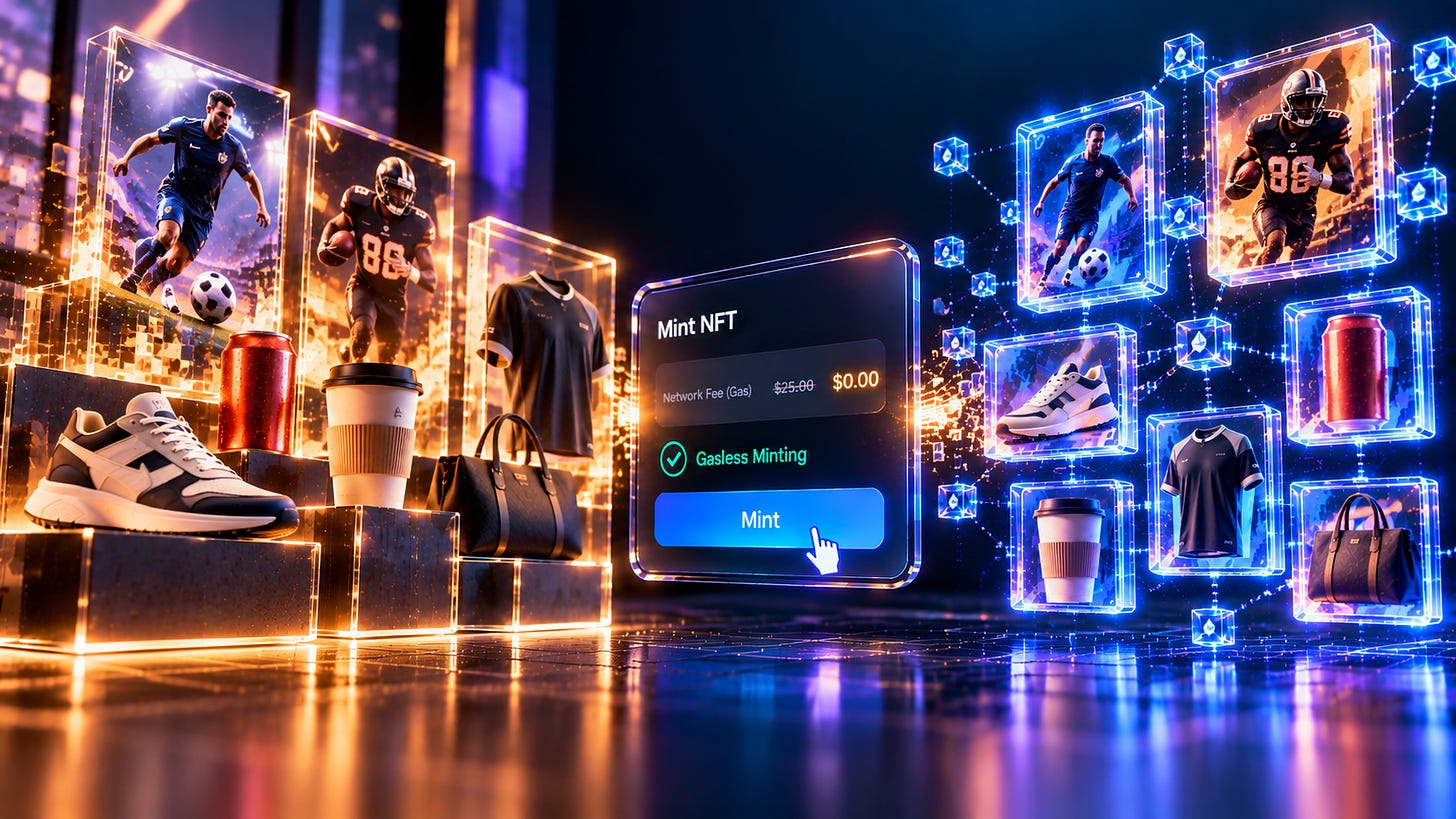
Mintable was one of the first platforms to offer gas-free minting. The NFT was created using a cryptographic signature and only written to the chain when it was first moved — so issuing a token cost close to nothing.
That changed the conversation with brands entirely. Suddenly an NFT didn’t have to be a $50,000 JPEG. It could be:
- a coupon or discount voucher
- the ticket to a football match
- a digital matchday programme
- a stamp in a loyalty programme
Everyone piled in
It is hard to overstate how mainstream this got, how quickly. In the space of about a year:
- Nike acquired NFT studio RTFKT in December 2021 and went on to generate over $185M in NFT revenue by mid-2022.
- Dolce & Gabbana (about $25M), Tiffany (about $12M, with NFTiffs for CryptoPunk holders), Gucci (about $11M) and Adidas (about $10M, with its Into the Metaverse drop) all built real NFT revenue lines.
- Coca-Cola, Budweiser and Visa all moved in, from Coca-Cola’s metaverse loot box to Visa buying a CryptoPunk for roughly $150,000 in ether.
- Football went all in. In September 2021 Sorare, an NFT fantasy football game, raised $680M led by SoftBank at a $4.3B valuation, Europe’s largest-ever Series B, with licences covering players from more than 180 clubs including Real Madrid, Liverpool and Juventus.
That was the backdrop to my own conversations. I was sitting with clubs like Real Madrid and Juventus, each with millions of digital fans around the world, working through how the matchday ticket, the programme and the fan reward could all become tokens. I was talking to Starbucks about running loyalty on-chain. Every week brought another global brand asking how fast it could launch. The potential felt endless, and with gasless minting the economics finally worked.
Then it stopped
The collapse was fast. NFT trading volume fell from roughly $17B in January 2022 to about $466M by September 2022 — a 97% drop in nine months, according to Dune Analytics data reported by Bloomberg. It was part of a wider $2 trillion crypto wipeout as rising interest rates drained speculative capital.
Brands followed the money out. Starbucks launched its Odyssey NFT loyalty beta on Polygon in late 2022, failed to sell out a $100-per-token collection in April 2023, and shut the programme on 31 March 2024. GameStop closed its NFT marketplace, X dropped NFT profile pictures, and Meta wound down its own NFT features.
Inside Mintable, the effect was the same. Ripple’s Creator Fund was effectively pulled back, the deals on the table stalled, marketplace volume disappeared, and Mintable as an NFT marketplace eventually wound down.
A Bored Ape, then and now
The cleanest illustration is the Bored Ape Yacht Club, the collection that became shorthand for the whole era:
- Mint, April 2021: 0.08 ETH (about $200)
- Peak floor, April 2022: 152 ETH (about $434,000)
- Floor, April 2026: about $10,700
- Floor, July 2026 (after a rally): 15 ETH (about $30,000)
Even after this year’s bounce, the cheapest Ape costs more than 90% less than it did at the top.
Not all of the volume was real
Part of the boom was manufactured.
- The $532M Punk. In October 2021, CryptoPunk #9998 “sold” for 124,457 ETH, about $532M. It was a flash-loan trade with itself: the buyer and seller were effectively the same party, and the Punk was relisted at 250,000 ETH (over $1B). Its creators, Larva Labs, struck the sale from the record.
- OpenSea’s insider case. In June 2022, OpenSea’s head of product, Nate Chastain, was charged with buying NFTs he knew were about to be featured on the homepage, then selling them after the price jumped. It was billed as the first digital-asset insider trading case. He was convicted in 2023, but an appeals court overturned the conviction in July 2025 and prosecutors chose not to retry.
OpenSea itself survived by becoming something else. By October 2025 it was doing $2.6B a month in volume, more than 90% of it fungible token trading rather than NFTs. Its CEO described NFTs as “chapter one.”
The pivot: from marketplace to infrastructure
I saw where this was heading and pushed the business toward a SaaS model. Instead of depending on trading volume and secondary-market fees, brands could mint and manage NFTs on a fixed, tiered monthly subscription.
The insight was straightforward: brands never wanted speculation. They wanted a reliable piece of infrastructure that made a loyalty or engagement programme work — with the blockchain invisible to the end customer.
Case study: Station Casinos and STN Charms
The best example of that thesis was Station Casinos, the Las Vegas operator owned by Nasdaq-listed Red Rock Resorts.
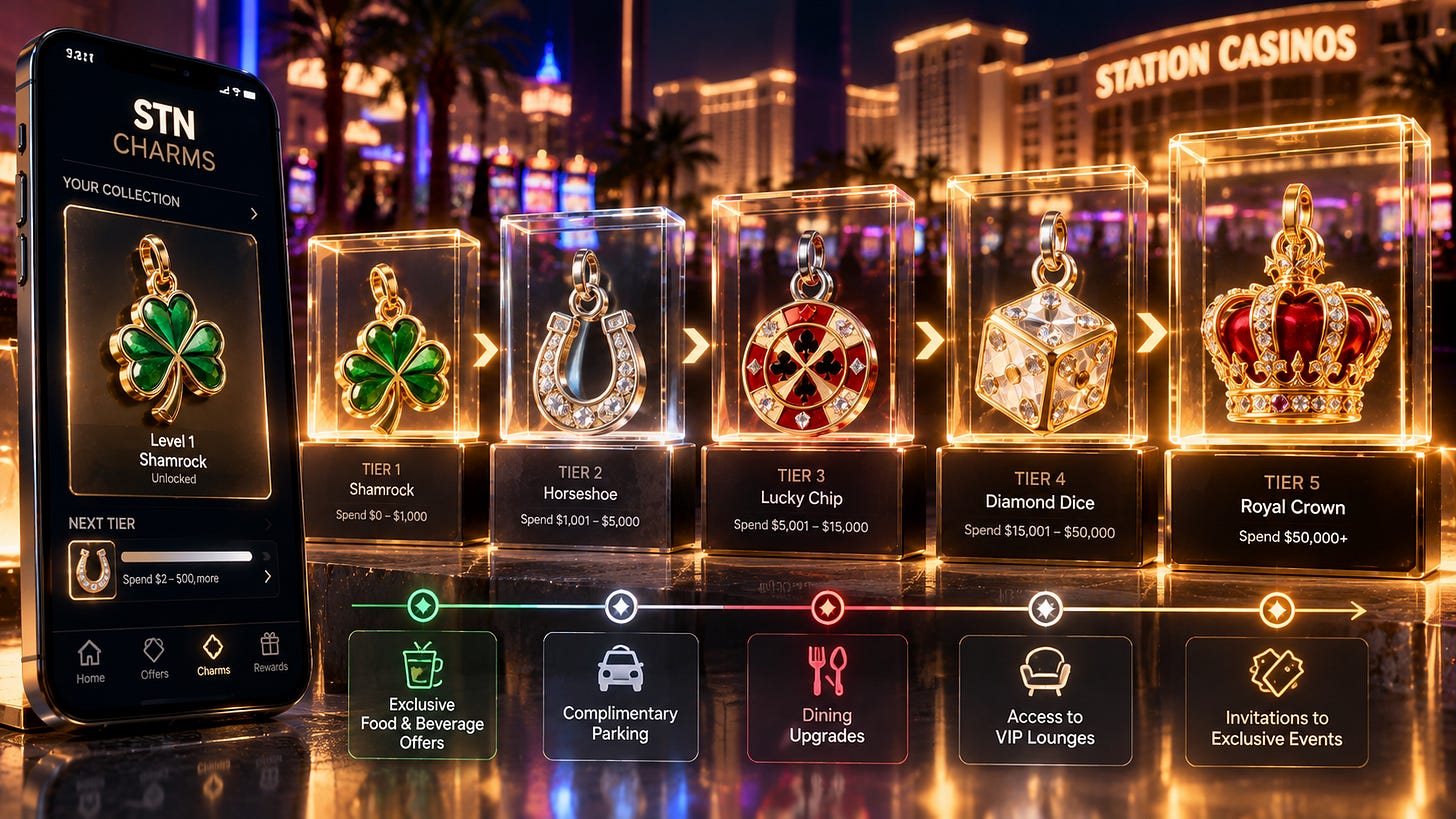
On 31 March 2023, Station Casinos launched STN Charms, an NFT layer on top of its existing Boarding Pass loyalty programme, live across all its properties:
- Zero onboarding friction. Every Boarding Pass member was auto-enrolled. When a player carded in at a slot machine, they received a debut shamrock Charm, displayed on the machine’s service window.
- Gamified, not speculative. Charms “level up in luck” as guests win. The design drew on mobile games like Candy Crush and on the lucky charms players already bring to the casino floor — what Station called a “game within the game”, aimed at younger guests.
- A real marketplace. Players could view, buy and sell Charms on an STN Charms website.
- Mintable as the platform. Station built STN Charms with Mintable, whose platform handled buying, selling and displaying the NFTs, and Intergalactic Agency, which designed the Charms experience. Trustly was later brought in as exclusive payments provider, with CentralAMS operating the wallets as merchant of record.
What makes this case credible is that Station Casinos backed it with intellectual property. Its team filed patents on the system and was granted several, including:
- US 11,783,672 (granted October 2023) — a casino loyalty system that awards NFT Charms and records them on a blockchain ledger
- US 12,056,784 (August 2024) and US 12,315,338 (May 2025) — querying a blockchain to identify a patron’s Charm NFT and rendering it on the game screen of an electronic gaming machine
A listed casino operator does not file and prosecute a patent family for a fad. It does that when it believes the mechanic is a durable piece of its loyalty stack. Whatever happened to STN Charms after the market turned, the patents stand as a record of how seriously a public company took the idea.
The lesson: the NFT worked when the customer never had to think about it being an NFT.
The metaverse parallel
We weren’t the only ones caught up in it. In late 2021 Facebook renamed itself Meta, betting the company’s identity on the metaverse. Reality Labs has since accumulated more than $80B in operating losses, and in early 2026 Meta cut over 1,000 roles there and shifted focus to AI and smart glasses. If one of the best-resourced companies in the world can rename itself around a trend that then stalls, it shows how hard these cycles are to call in real time.
Where NFTs landed: the birth of tokenization literacy

Here is my argument: for millions of people, the NFT boom was the onboarding and experimentation phase for tokenization.
Millions of people learned, mostly by doing, what a wallet is, what on-chain ownership means, what provenance and programmability look like. The primitive was right. The asset was wrong. Putting a JPEG on-chain was never the point — putting things of real economic value on-chain was.
That is exactly where the industry has gone:
- On-chain tokenized real-world assets (excluding stablecoins) are now in the low-to-mid $30 billions, per RWA.xyz — roughly four times early-2025 levels.
- Tokenized US Treasuries alone passed $15B in May 2026.
- BlackRock, Franklin Templeton, Apollo and others now run live tokenized products, and DTCC is launching tokenization at market-infrastructure scale.
NFTs didn’t create that market. Institutions arrived for their own reasons: yield, settlement speed, regulatory clarity. But the NFT era was the public experiment that made wallets, digital ownership and programmable assets familiar to a mainstream audience. My own later work, on tokenized real estate and CBDC pilots with the HKMA and stablecoins at Ripple, builds on those same foundations.
What I took away
- Easy money distorts every signal. When raising is easier than earning, teams optimise for the next round, not the next customer.
- Utility beats speculation. The use cases that survived — loyalty, ticketing, access — were the ones where the token was a tool, not the product.
- Abstract the chain away. Gasless minting and auto-enrolment worked because they removed friction the customer should never see.
- Distribution beats technology. The tech was largely solved. What mattered was whether a brand with real customers would deploy it.
- Nobody calls the top. Not the VCs, not the Layer 1s, not Mark Zuckerberg.

It was a fun ride. Crazy money was coming in, it felt exhilarating, and many smart people believed it was the future. Much of it was froth.
When Ripple launched the Creator Fund in September 2021, its announcement ran under the heading “The Future Will Be Tokenized”, and cited a World Economic Forum projection that 10% of global GDP would be tokenized by 2027. It saw NFTs as the tipping point for mainstream adoption.
I agree the future will be tokenized. Just not in the way Ripple, or any of us, imagined when that fund launched. It won’t be JPEGs. It will be treasuries, deposits, real estate and money itself. I remain a firm believer in tokenized assets on-chain. I was just never a fan of the JPEG.
And all was not lost. Working with Ripple on the Creator Fund is how I built strong relationships there, and those relationships led me to join Ripple to run its CBDC and tokenization business.
Author’s note: while writing this, I found out that Mintable was sunset earlier this year, its marketplace going offline in July 2026. It wasn’t alone. Foundation, Magic Eden’s NFT marketplaces and others have closed or pivoted in 2026. It is the end of an era, and a shame. I have a lot of respect for Zach Burks, Mintable’s founder and CEO, a genuinely nice and very smart guy, and for everything the team built.
Also published on Substack and LinkedIn.
Sources
- The Block — Mintable $13M Series A (July 2021)
- Crowdfund Insider — Mintable Series A, gas-free minting
- Ripple — Calling All Creators: Ripple Launches $250M Creator Fund
- CoinDesk — Ripple launches $250M NFT fund
- K33 Research — Ethereum fees, 2021
- K33 Research — Otherdeed mint fee record
- FashionNetwork — brand NFT revenue
- DappRadar — brands entering NFTs
- City A.M. — Sorare $680M Series B
- Bloomberg — NFT volumes tumble 97%
- The Block — Starbucks Odyssey closure
- Blockworks — brands sunsetting NFT programmes
- The Block — BAYC record floor
- Cryptoast — BAYC floor July 2026
- Winston & Strawn — CryptoPunk 9998 wash trade
- Cointelegraph — Chastain conviction overturned
- The Block — OpenSea volume shift to token trading
- Gaming America — STN Charms launch, Mintable partnership
- Bonus.com — STN Charms details
- Business Wire — Trustly x Station Casinos
- Google Patents — US11783672B2
- Justia — Station Casinos inventor patents
- Outlook Respawn — Reality Labs losses
- Anadolu — Reality Labs Q2 2026
- Stobox — State of RWA 2026
- Mean CEO — RWA.xyz statistics May 2026
Digital assets & payments · Singapore