A small Pacific nation tried to build its own digital dollar without a central bank. The blockchain worked. The real challenges were law, banking and trust.
In July 2023, the Republic of Palau launched one of the most unusual experiments in digital money: a government-issued, US dollar–backed stablecoin called the Palau Stablecoin, or "Kluk". I led the project for Ripple, managing its execution from Singapore.
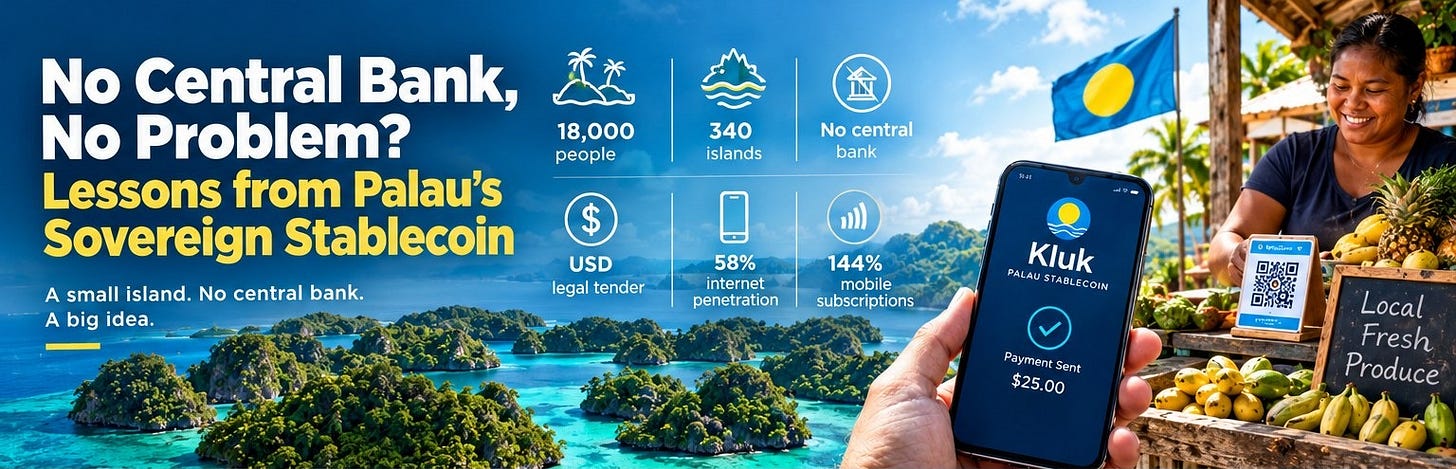
Palau has roughly 18,000 people, no central bank and no national currency of its own. It relies on the US dollar, physical cash and imported financial infrastructure to move money around its islands.
The question was deceptively simple: could a government give its citizens a faster, cheaper way to use the dollars they already had?
We proved the technology could work. But getting from a successful pilot to a sustainable national payment system turned out to be a much bigger challenge. Here is what we learned — and why it matters well beyond Palau.
Palau at a glance
Palau sits in the western Pacific, about 800 km east of the Philippines: an archipelago of roughly 340 islands, most of them the uninhabited limestone Rock Islands, whose Southern Lagoon is a UNESCO World Heritage site. It became independent in 1994 under a Compact of Free Association with the United States, uses the US dollar, and runs an economy built largely on tourism and diving.
It is also a country that likes to go first. In 2017 it became the first nation to ask every visitor to sign an environmental pledge stamped into their passport. A government-issued digital dollar fitted the same instinct.

Why Palau is a unique test case
Palau has no central bank, no national currency and no domestic payment system. It uses the US dollar as legal tender under its Compact of Free Association with the United States, and relies on US financial market infrastructure to move money.
That creates an unusual set of constraints:
The banks are branches, not local institutions. Three FDIC-insured US bank branches — Bank of Guam, Bank of Hawaii and BankPacific — hold about 98% of deposits. They invest mostly offshore; net foreign assets are roughly nine times domestic private credit.
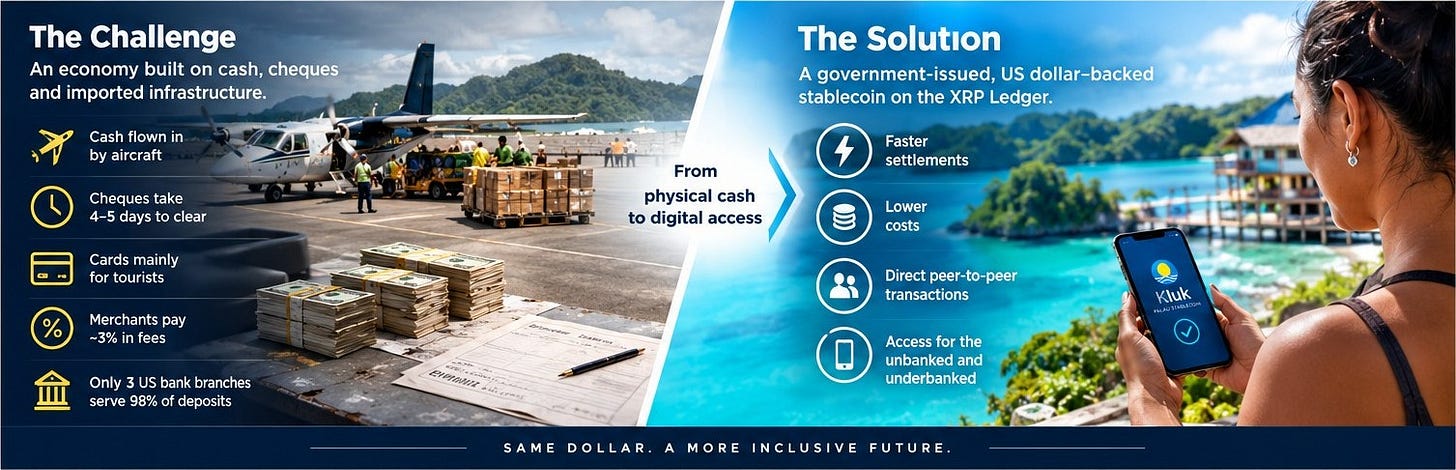
Payments are slow and analogue. Cheques take four to five business days to clear. Cash and cheques still dominate retail; cards work mainly in tourist businesses. Merchants pay around 3% on card acceptance, a figure President Whipps cited directly when backing the pilot.
Connectivity is mobile-first. Internet penetration is about 58%, but mobile subscriptions run at 144% of the population.
Correspondent banking is fragile. Across the Pacific, de-risking has steadily cut USD correspondent links; a World Bank–backed regional programme only became operational in 2025 to protect what remains.
Remote islands are underserved. Branch access is concentrated around Koror; outer islands have limited banking.
Palau's Minister of Finance, Kaleb Udui Jr., sets out the problem plainly in this short explainer. On cash logistics:
"The actual physical currency logistics of it is one of the challenges that is heightened here in Palau... money is brought in by commercial banks usually via aircraft, so that itself is an expensive way to cargo in money. We don't have security services here, so there's a lot of risk."
On why a government stablecoin is, in effect, a CBDC:
"Palau does not have a central bank, so the government issuing a stablecoin is tantamount to being a Central Bank Digital Currency."
And on who it is for:
"There are a lot of people here who are unbanked, they don't have access to the financial system... we feel that these particular people will benefit the most."
Outside Koror, residents must travel to the capital to reach an ATM or a bank. The Minister's goal was to let them transact with each other directly and affordably, without either.
The result is a large unbanked and underbanked population inside a dollarised economy. The Ministry of Finance set the goal explicitly: a convenient, low-cost national payment ecosystem built for Palau's unbanked and underbanked residents. A sovereign stablecoin was a way to give the government a programmable, domestically controlled version of the currency it already uses — without building a central bank.
The ambition was set high from the start. When Palau and Ripple announced their partnership in November 2021, the stated goal was to explore the world's first government-issued national stablecoin, with an initial focus on cross-border payments strategy. President Surangel Whipps Jr. put it bluntly to Al Jazeera: "Having a digital currency in some ways kind of eliminates the need for a bank."
The hidden cost of cash
I first saw the economics of cash up close long before stablecoins, building embedded finance with mobile network operators at Experian.
We launched Dynamic Airtime Advance — small-ticket credit delivered through operator APIs — across Southeast Asia, starting with one of Indonesia’s leading mobile operators and expanding into the Philippines, Malaysia, Thailand, Vietnam, Myanmar, India, Sri Lanka, Nepal and Bangladesh. The product was digital. The economies around it mostly were not.
The pattern was the same in every market:
Moving cash is expensive. Every dollar has to be counted, transported, insured, guarded and reconciled. Those costs land on merchants, agents and ultimately customers.
Collecting cash is harder than disbursing it. Repayments, top-ups and bill payments depend on physical agent networks that are costly to build and to supervise.
Cash is a security problem. Stock-outs, theft and robbery risk shape where agents operate and how long they stay open.
Cash is invisible. No data trail means no credit history, which keeps people locked out of the products that would help them most.
QR-based mobile money and operator wallets solved part of this. What they did not solve was settlement: the money still had to land in a bank somewhere, through rails the country often didn't control.
That is why Palau caught my attention. It is a small, extreme version of the same problem: a cash economy whose dollars are flown in by plane, guarded without a dedicated security service, and issued, cleared and settled abroad.
What was actually built
In plain English, PSC was a government-issued, US dollar–backed digital token. Three things define it: the technology it ran on, who issued it, and how it was classified legally — and in Palau those three point in different directions.
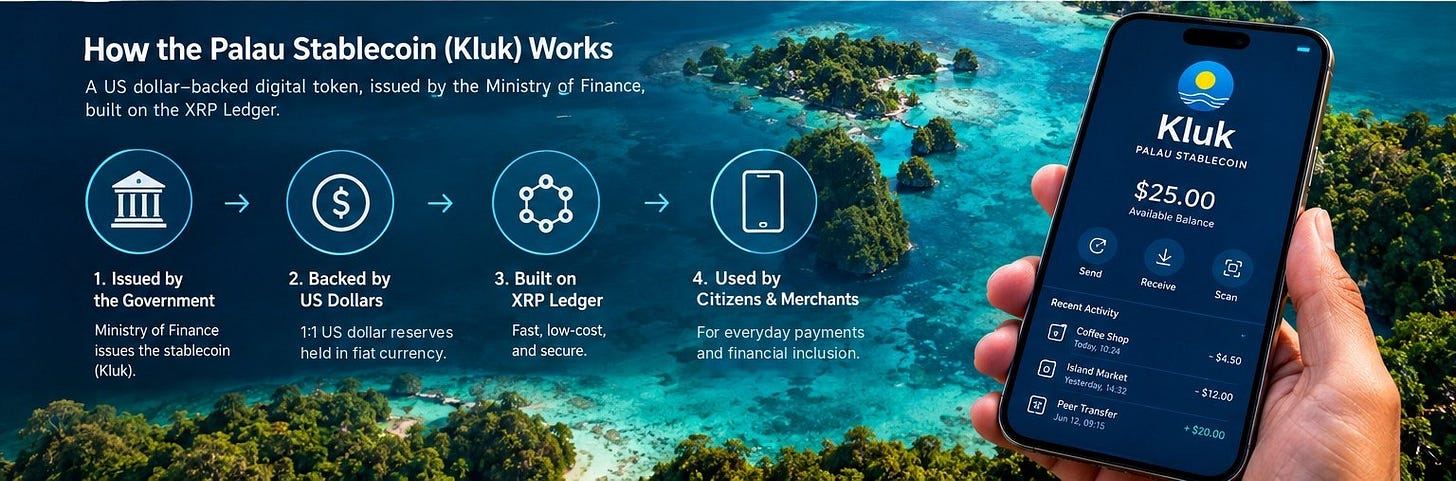
Ripple ran the full stack, built on its CBDC Platform with the XRP Ledger as the payments ledger. The platform has four layers:
Issuer: lets a central bank, monetary authority or commercial bank run the full lifecycle of a fiat-backed digital currency — mint, distribute, redeem, destroy — secured by the XRP Ledger's multi-signing. In Palau, this role sat with the Ministry of Finance.
Operator: lets banks and non-bank institutions holding large balances manage their holdings and handle inter-institutional settlement and distribution.
End-user wallets: let businesses and individuals hold, send, receive and pay.
Ledger: records transactions and settles them, with the programmability and controls a monetary authority needs.
On top of this we built a bespoke administrative layer so the Ministry could oversee issuance, circulation and cash management internally.
Here is the nuance that makes Palau interesting: technically, this was a CBDC project. It used CBDC infrastructure, and the issuer was the state. But with no central bank to issue it, the result was legally a sovereign stablecoin — a government-issued, fully reserved dollar token. As the Minister put it, in Palau the two become the same thing.
Operationally, the model followed reserve-backed private stablecoins such as USDC and USDT — with one difference: the issuer was a sovereign Ministry of Finance, not a company. The token even had its own identity: the Palau Money Bird as its digital image.
Backing: 1:1 US dollar reserves in fiat currency.
Flow: volunteer government employees received PSC in wallets and spent it at participating merchants, who could convert PSC into funds in their local bank accounts.
Funding: the pilot ran at almost no cost to the state; Ripple put $25,000 into the National Treasury to fund the wallets.
Backing was a real design debate. Gold-backed reserves were discussed during the project but never released. The team settled on 1:1 fiat dollar reserves: simple to verify, aligned with the currency Palauans already use, and redeemable at par through local banks. The gold discussion is a reminder that small states see sovereign tokens as more than payments — they are also a question of reserve strategy.
Phase One ran in mid-2023 with up to 200 executive-branch volunteers, each given 100 PSC, spending at local merchants including Surangel and Sons, The Penthouse Hotel and King's Minute Mart. Distribution stopped on 8 September and the token was frozen after 15 September so the Ministry could survey users. Its report, published on 7 December 2023, recorded more than 700 transactions, over 400 of them merchant payments. Most survey respondents said they would favour PSC if the government approved a national rollout.
It is worth being precise about what this proved. The pilot showed that the system worked end to end and that people would use it. Seven hundred transactions are real evidence of use — but not, on their own, proof of national-scale demand. Pilot success and programme success are different tests, and Palau passed the first while the second still depends on law, custody and banking.
Phase 2a, completed in June 2024, moved from pilot to design: revalidating use cases with stakeholders, modelling the service on wallets like PayPal and Alipay adapted to Palau, and drafting a Payment Service Bill to give it a legal footing.
The technology worked. That turned out to be the easy part.
The hard part: mandate, custody and trust
Palau's pilot stalled on institutions, not code. Three issues stand out.
1. Legal mandate. Senators challenged whether the Ministry had authority to run the pilot, and one called Ripple's funding a conflict. The Public Auditor's June 2025 report found that neither the MoU nor the services agreement had been certified by the Attorney General as Palauan law requires. It found no misuse of resources, but concluded that a circulating national stablecoin needs an act of Congress.
The government's reasoning was deliberate: experiment first, learn the pitfalls, then send Congress a bill grounded in evidence. It is a defensible approach for a small state with limited capacity — but it put the legal debate after the launch instead of before it.
2. Custody of reserves. A fully reserved token needs a bank to hold the reserves. According to the IMF, the initiative went on hold after the pilot because Palau could not find a custodian bank — and the two main commercial banks have not bought in. Without a central bank, there is no obvious home for the money behind the money.
3. The last mile. The people PSC was built for — unbanked and underbanked residents, especially on the outer islands — need physical places to cash in and cash out. The IMF notes remote islands lack banking facilities for redemption, and recommends an independent feasibility study comparing the token with fast payments and licensed mobile money.
Where it stands. The pilot did what it set out to do: it proved the technology, the operating model and user demand. The next step is political. In July 2025 President Whipps sent Congress a digital payments bill — referred to by the IMF as the Palau Digital Service Bill — which would let the Ministry issue "tokenized dollars" in a phone wallet, each backed by a US dollar in a government-controlled account and redeemable for cash at any time. As of the latest public reporting, the bill is still under review. I'm no longer involved in the project, so the timing now rests with Palau's lawmakers — but the groundwork is in place.
From CBDCs to stablecoins
Palau landed on a stablecoin by necessity. Many larger economies are now arriving at a similar place by choice. Each example below makes the same point: the future of digital money depends as much on who issues it, who safeguards its backing and who regulates it as on the technology carrying it.
For most of the last decade, central bank digital currencies were the default answer to digital money. That has shifted. Retail CBDCs raised hard questions about privacy, about disintermediating commercial banks, and about whether people actually wanted them over the payment apps they already use. Meanwhile, regulated stablecoins offered much of the same benefit with private-sector distribution.
Hong Kong shows the shift clearly. The HKMA has explored e-HKD since 2017 and ran a two-phase retail pilot. In October 2025 it concluded that the immediate priority for e-HKD lies beyond retail use cases, and refocused it on wholesale settlement, tokenisation and cross-border payments. In parallel, Hong Kong's Stablecoins Ordinance took effect on 1 August 2025, and in April 2026 the HKMA granted its first stablecoin issuer licences — to Anchorpoint Financial (a Standard Chartered, Animoca Brands and HKT joint venture) and to HSBC.
The US went further. A January 2025 executive order barred federal agencies from establishing, issuing or promoting a CBDC, while explicitly encouraging lawful dollar-backed stablecoins. The GENIUS Act followed in July 2025.
Europe is the exception — and even there, wholesale came first. On 21 September 2026 the Eurosystem launched Pontes, which settles wholesale tokenised transactions between institutions in central bank money. The retail digital euro is still in EU trilogue negotiations; the ECB plans a pilot from the second half of 2027 and is aiming for a potential first issuance in 2029. So for retail money, the momentum has largely moved from central banks issuing tokens to central banks regulating them.
I worked on both Palau and Hong Kong's CBDC and bank-issued stablecoin testing, and the pattern is clear. The technology was never the bottleneck. The real question is who issues, who holds the reserves, and who carries the trust. Palau answered it with a ministry and a fully reserved dollar. Hong Kong answered it with licensed banks. Both answers point to the same destination: regulated, fully backed tokens running on shared infrastructure.
Lessons for small economies and sovereign issuers
The takeaway is not "sovereign stablecoins don't work". It is that the order of operations matters.
Legislate first, pilot second. A clear legal basis, signed off before launch, protects the issuer, the vendor and the project's reputation.
Solve custody before code. Decide where reserves sit, who supervises the custodian and how reserves are reported. Without a central bank, this is the critical path.
Ring-fence and publish the reserves. Segregated accounts, independent attestations and clear redemption rights are what make a government token trustworthy.
Bring the banks in early. If the institutions that hold deposits see the token as a competitor, adoption stalls. Make them distribution partners.
Design for cash-in and cash-out. Digital money only reaches cash-heavy communities if there are physical places to convert. This is what mobile money learned the hard way.
Fund it independently. Vendor-funded pilots are fast but invite conflict-of-interest questions. A small public budget buys legitimacy.
Measure the alternatives honestly. A tokenized dollar should beat fast payments and mobile money on cost and reach — not just on novelty.
The context has also shifted since 2023. The US GENIUS Act, signed in July 2025, set federal rules for payment stablecoins, and regulators in Singapore and Hong Kong now run stablecoin regimes. Small dollarised and cash-heavy economies — across the Pacific, the Caribbean and parts of Africa — will increasingly ask whether to issue their own token or adopt regulated ones. Palau has already done the first draft of that experiment.
Closing thought
Palau showed that a country with no central bank can mint, distribute and redeem a digital version of its currency in weeks. It also showed that the hard work sits in law, custody and trust. Those are solvable problems — and the countries that solve them first will have a genuine alternative to cash and slow, expensive correspondent rails.
If you're working on payments in small or cash-heavy economies, I'd like to compare notes.
Jason Fullam is a digital assets and payments professional with 20+ years across cross-border payments, embedded finance and stablecoins, including roles at Ripple and Experian. More on the Palau project and my other work at jasonfullam.com.
Sources
Palau stablecoin explainer — Minister of Finance Kaleb Udui Jr.
Ripple: Palau launches USD-backed Palau Stablecoin (Jul 2023)
Al Jazeera: Tiny Palau seeks to blaze trail with official cryptocurrency (Dec 2021)
Cointelegraph: Hong Kong issues first stablecoin licences (Apr 2026)
White House: digital financial technology executive order (Jan 2025)
Also published on Substack.

Digital assets & payments · Singapore