
For decades, the global financial system has been built around intermediaries.
Banks hold our deposits and decide who gets credit. Card networks connect merchants, banks and consumers. Payment processors move money between businesses and customers. Correspondent banks and messaging networks help money cross borders. Each layer adds value, but each also creates friction, cost and an opportunity to capture a share of the economics.
That model is now being challenged.
Stablecoins, blockchain-based settlement, embedded wallets and new financial infrastructure are making it possible to move value globally without relying on every traditional intermediary in the chain. What once required a network of banks, payment processors and clearing systems can increasingly be coordinated through software, digital assets and programmable financial infrastructure.
The technology is important. But the more interesting question is commercial.
If money can move without the intermediaries that have historically controlled it, who captures the value instead?
Will it be the fintech platforms building integrated financial infrastructure? Stablecoin issuers accumulating global liquidity? Banks defending their deposits and lending franchises? Or payment giants such as Visa and Mastercard, which have spent decades building trusted global networks?
The answer may determine who controls the next generation of financial services.
And the biggest prize may not be payments at all. It may be the relationship with the customer — and the ability to provide everything that follows: savings, credit, lending and access to financial products.
1. Disintermediation was always the point
Bitcoin's original proposition was radical: enable people to transfer value directly, without needing a bank or payment company to approve and process every transaction.
Since then, the blockchain industry has built a vast ecosystem of networks, wallets, exchanges, protocols and applications. Yet there is a paradox at the heart of the sector.
Many blockchain projects have focused on building faster, cheaper or more scalable networks, while the majority of consumers continue to access digital assets through centralised exchanges, custodians and familiar financial applications.
The infrastructure has advanced faster than the everyday user experience.
For most people, the attraction of a new financial system is not the blockchain itself. They want to receive money quickly, pay less to send it abroad, access savings, obtain credit and manage their finances without unnecessary complexity.
The underlying technology should make those experiences better without requiring consumers to understand how it works.
This is where stablecoins become particularly significant. They combine the familiarity of a currency such as the US dollar with the ability to transfer value over digital networks. They can be held in wallets, transferred across borders and used as a settlement asset by businesses and financial institutions.
They do not automatically eliminate intermediaries. Issuers, custodians, exchanges, wallet providers and on- and off-ramps still play important roles. Nor does moving a transaction onto a blockchain necessarily remove regulation, credit risk or the need for trusted institutions.
But stablecoins create a new opportunity: the financial service no longer has to be tied to the traditional banking and payment infrastructure that originally delivered it.
That changes the competitive landscape.
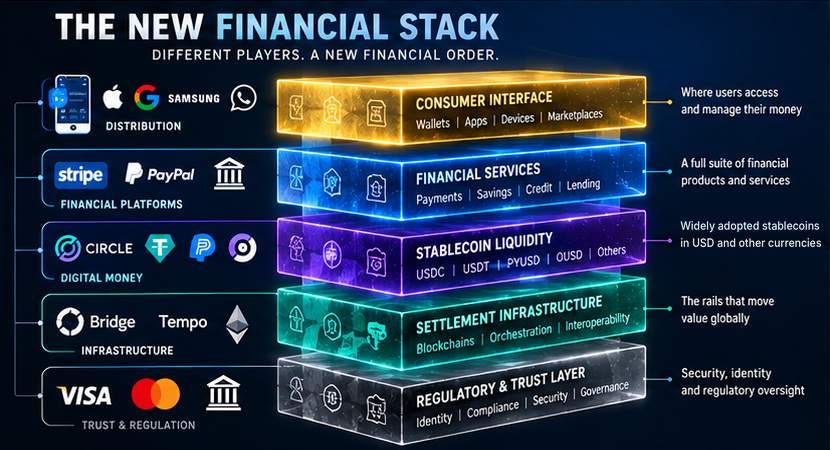
The winners will not necessarily be the companies with the fastest blockchains. They will be the companies that make the infrastructure useful, distribute it at scale and establish a trusted relationship with the people and businesses using it.
2. The payment giants are adapting — not surrendering
Visa and Mastercard are often presented as potential casualties of financial disintermediation. If stablecoins can move money directly between wallets, why should a transaction need a card network?
It is a reasonable question. But it underestimates the value these companies provide beyond the movement of money itself.
Their networks connect millions of merchants, financial institutions and consumers. They have established standards for security, fraud prevention, dispute resolution and global acceptance. Replacing those capabilities is considerably more difficult than replacing a settlement rail.
Both companies are already moving into the stablecoin ecosystem.
Visa has expanded its stablecoin settlement capabilities and launched USDC settlement for participating US financial institutions. Its approach allows institutions to use blockchain-based settlement while preserving the familiar consumer card experience.
Mastercard has also announced support for regulated stablecoins in its settlement network, including USDC, PYUSD and other supported assets. Its strategy is to give partners more flexibility over how and when transactions settle, rather than insist that every payment follow a traditional settlement process.
This is an important distinction. These companies are not necessarily trying to prevent the financial system from changing. They are trying to ensure they remain relevant as it does.
But the long-term question is whether they can retain the same position if the customer relationship moves elsewhere.
Imagine a consumer holding dollar stablecoins in a wallet, paying a merchant directly and using a stablecoin-backed card only when necessary. The payment network might still provide acceptance, security and compliance, but it could become one component of a much broader financial service rather than the central point of control.
Over time, Visa and Mastercard may need to evolve from being primarily associated with card-based transactions towards providing a wider range of services around identity, trust, fraud prevention, compliance and interoperability.
Their networks remain powerful assets. The challenge is ensuring those assets matter in a world where the underlying movement of money becomes less dependent on traditional card rails.
3. Stripe may have one of the strongest positions
If there is one company worth watching closely in this transition, it is Stripe.
Stripe already sits at the intersection of businesses, consumers and digital commerce. Its existing payments business gives it distribution, merchant relationships and a deep understanding of how money moves through the internet.
It has also been assembling the components needed to extend that position into stablecoin-based financial services.
Its acquisition of Bridge added stablecoin infrastructure and orchestration capabilities. Its acquisition of Privy brought embedded wallet technology into the Stripe ecosystem. Stripe has also developed Tempo, its own blockchain network, as part of its broader investment in stablecoin and payments infrastructure.
Taken together, these capabilities point towards a compelling strategic position.
Stripe can help businesses accept payments, move money between currencies and payment systems, manage stablecoin flows and integrate wallet functionality into their products. Its infrastructure can abstract away much of the technical complexity, allowing a business to offer financial services without building every component itself.
That is a potentially powerful advantage.
Consider a global marketplace paying sellers in different countries. Today, the process may involve multiple payment providers, banking relationships, foreign exchange conversions and settlement delays. Stablecoin infrastructure could simplify parts of that process, while Stripe could provide the orchestration and merchant-facing interface.
Now extend the idea beyond business payments.
What if a platform could offer a customer a wallet, receive income, make payments, hold stablecoins, convert currencies and access additional financial products through one integrated experience?
Stripe would not need to become a traditional bank in every market to participate in that opportunity. It could provide the infrastructure and partner with regulated institutions where licences, custody or lending arrangements require them.
This is the bigger strategic possibility: Stripe could become a major orchestration layer for internet-native financial services.
The company would not necessarily need to own every asset or process every transaction itself. It would need to control enough of the integration, distribution and customer experience to remain indispensable.
That is a very different proposition from simply processing card payments.
4. The battle is over the wallet — and what comes after it
The next major battleground may be the consumer wallet.
For years, crypto wallets have largely been designed for people already familiar with digital assets. Mainstream consumers have generally preferred familiar banking applications, payment cards and mobile wallets.
But the experience is changing. Embedded wallets can allow people to interact with digital assets without having to navigate seed phrases, complicated blockchain interfaces or separate crypto applications.
Smartphones could become a particularly important distribution channel. If stablecoin payments can be integrated into the wallets and payment experiences people already use, consumers may be able to send money directly to one another or pay merchants without needing to understand the settlement infrastructure underneath.
The opportunity extends beyond specialist crypto companies.
Technology platforms, mobile operating systems, mobile network operators, merchants and fintech applications all have potential distribution advantages. They already have access to consumers and, in some cases, trusted relationships that financial infrastructure providers must work hard to establish.
For mobile network operators, the opportunity could be especially relevant in emerging markets, where mobile channels may offer a more accessible route to financial services than traditional bank branches.
But a wallet is only the beginning.
Whoever controls the primary financial interface has the potential to expand into savings, credit, insurance, remittances and other services. The wallet becomes the entry point to a broader financial relationship.
That is why this competition matters so much.
The greatest value may not come from moving money from one place to another. It may come from knowing where money sits, understanding how it is used and being positioned to provide the next financial product the customer needs.
5. Circle and Tether: the power of the money itself
Stripe represents the orchestration and distribution opportunity. Circle and Tether represent a different source of power: the stablecoin itself.
Stablecoin issuers can become important financial infrastructure providers because their assets are used for payments, trading, settlement and as a store of value. A widely adopted stablecoin can benefit from liquidity, integration and network effects: the more people and businesses accept it, the more useful it becomes.
Tether's USDT has established a major position in global crypto markets and is widely used in markets where access to dollar-denominated value is important. Its business model also demonstrates how issuing a stablecoin can generate revenue from the assets backing the tokens, subject to operating costs, risks and applicable requirements.
Circle's USDC has built a substantial role in the institutional and business ecosystem, supported by integrations with payment providers and blockchain networks. As more businesses use stablecoins for settlement, treasury operations and cross-border transfers, the issuer can become an important part of the financial stack.
But there is a strategic distinction between being the issuer of a widely used stablecoin and controlling the customer relationship around it.
A stablecoin may be held in a wallet provided by another company, distributed through a fintech application or used in a payment service orchestrated by a third party. The issuer may earn revenue from the reserve assets, while another company owns the interface, manages the transaction flow or sells additional financial products.
That creates both an opportunity and a risk.
Circle and Tether could become foundational providers of digital money. But if another platform controls distribution and customer access, the issuer may not capture the full economic value created by the ecosystem.
The question is whether stablecoin issuers can expand beyond the asset itself into the services and relationships built around it — or whether they remain the monetary infrastructure powering someone else's financial platform.
6. PayPal, Ripple and the fight to own more of the stack
The competitive landscape is not limited to Stripe, Circle and Tether.
PayPal has an enormous consumer and merchant footprint, alongside its PYUSD stablecoin, issued by Paxos. Its existing distribution gives it a route to bring stablecoin functionality to users who may never think of themselves as crypto customers.
However, PayPal's position also illustrates how the economics and control of a financial product can be divided between the company distributing it and the company issuing the underlying asset.
That division is not necessarily a weakness. Partnerships can accelerate adoption. But the strategic question is how much of the value and customer relationship each participant ultimately retains.
Ripple is another contender, with a long-standing focus on cross-border payments and financial institutions. Its payments network, institutional relationships and RLUSD stablecoin give it a position from which to participate in the shift towards blockchain-based settlement.
Different companies are approaching the opportunity from different starting points. Some already own consumer distribution. Others have institutional relationships, stablecoin liquidity, wallet technology or payment infrastructure.
No single capability guarantees success.
The companies best positioned to win may be those that can combine several of these advantages without making the experience more complicated for the customer.
7. The consortium approach: cooperation today, competition tomorrow?
Another important development is the emergence of industry consortiums.
Open Standard, whose founding companies include Coinbase, Mastercard, Shopify, Stripe and Visa, launched Open USD (OUSD) in September 2026. OUSD is issued by Bridge, a Stripe company. The initiative aims to provide businesses with a common stablecoin infrastructure that can be accessed through multiple integration paths.
The concept is commercially significant. Shared infrastructure can reduce friction for businesses, make integration easier and encourage adoption across a wider ecosystem.
But consortiums contain an inherent tension.
The members may cooperate because a common standard benefits everyone. At the same time, many of those members compete directly for customers, transactions and control of the financial relationship.
What happens when their commercial interests diverge?
A platform may initially support an open ecosystem while adoption is the priority. Later, it may have incentives to favour its own products, direct activity through its own infrastructure or capture more of the economics.
That does not mean the consortium approach will fail. Common standards can be valuable, and cooperation can accelerate adoption. But the long-term balance between interoperability and commercial control will be important.
The question is not simply whether an open standard gains traction. It is who controls the distribution, customer interface and financial services built on top of it.
8. Banks are not going to stand still
It would be a mistake to assume that banks will simply lose this battle.
Banks already possess several formidable advantages: customer deposits, lending relationships, regulatory permissions, risk-management capabilities and access to established financial infrastructure. They understand credit, have experience managing balance sheets and operate within regulatory frameworks that new entrants may find difficult to replicate.
They are also exploring tokenised deposits, blockchain-based settlement and new forms of digital money.
In September 2026, Reuters reported that a coalition of 21 financial institutions, including Goldman Sachs, Bank of America, Citi and Deutsche Bank, planned to establish a company to issue a US dollar-pegged stablecoin, with a target launch in the first half of 2027. The initiative illustrates that major financial institutions are not treating digital money as a peripheral experiment.
This should not be confused with an already established, unified tokenised-deposit network. It is a planned initiative, and its eventual adoption and commercial impact remain uncertain.
Nevertheless, the direction is clear: banks are exploring how to participate in the new infrastructure while preserving their role in the financial system.
Their strongest defence may not be to recreate every feature of a crypto-native platform. It may be to combine their existing advantages with new technology.
If banks can offer faster settlement, programmable money, improved cross-border services and competitive digital experiences, they may remain highly relevant. They could also use their balance sheets and lending capabilities to offer financial products that stablecoin-native competitors cannot provide as easily.
The danger for banks is not necessarily that customers abandon them overnight. It is that the customer relationship gradually fragments.
A consumer might keep a salary account at a bank but hold spending money in a stablecoin wallet, use a fintech platform for international transfers and obtain credit through another provider.
Each individual shift might appear small. Collectively, they could weaken the bank's position as the primary financial relationship.
9. The real prize is lending
Payments are an important entry point, but they may not be the biggest prize.
Moving money can be a relatively low-margin business, especially when competition drives fees down. Lending, by contrast, can generate significant returns when it is underwritten and priced properly — although those returns come with credit losses, funding costs, regulatory obligations and operational risk.
The company that controls a customer's wallet and financial activity may eventually be well positioned to offer more than payments.
It could help customers save, access credit, finance purchases or obtain small short-term loans. For businesses, it could offer working capital, treasury services and financing tied to their transaction flows.
This is where the future of financial disintermediation becomes particularly interesting.
Imagine a platform that can observe a customer's payment behaviour, income patterns and transaction history, subject to consent, privacy rules and applicable law. Combined with appropriate risk models and regulated lending capabilities, that information could help the platform assess creditworthiness and offer more relevant financial products.
In emerging markets, where many people and small businesses have limited access to traditional credit, the potential is significant. Stablecoins and mobile distribution could help make financial services more accessible, while alternative data and new underwriting approaches could expand the pool of people eligible for credit.
But access to data does not automatically create a good lending business. Responsible underwriting, affordability assessments, consumer protection, funding, collections and compliance remain essential.
Nor does a stablecoin wallet automatically confer the right to pay interest or extend credit. Those activities depend on the relevant legal and regulatory framework.
In the United States, for example, the GENIUS Act establishes a federal framework for payment stablecoins and prohibits permitted payment stablecoin issuers from paying holders interest or yield solely for holding the payment stablecoin, subject to the law's provisions. That does not eliminate the possibility of offering separate regulated savings, investment or credit products, but those products must be structured appropriately.
The long-term opportunity is therefore broader than becoming a stablecoin issuer.
It is to build a trusted financial relationship that can support multiple products — and to capture a meaningful share of the economics across that relationship.
10. Cross-border payments are the starting point, not the destination
Cross-border payments are among the clearest use cases for stablecoins today.
Traditional international transfers can involve multiple intermediaries, different banking hours, foreign exchange spreads, reconciliation delays and inconsistent access across markets. Stablecoin infrastructure can help reduce some of these frictions by enabling digital assets to move across supported networks outside conventional banking hours.
But simply replacing one payment rail with another is not the whole opportunity.
The longer-term possibility is a more integrated global financial system in which digital currencies can be exchanged, transferred and used within applications, with less dependence on the legacy sequence of correspondent banking relationships.
That could create opportunities in foreign exchange, merchant settlement, remittances, treasury management and international commerce.
It also raises questions about liquidity, local currency conversion, regulation and the availability of reliable on- and off-ramps. A dollar stablecoin is not automatically useful to someone who needs local currency to pay rent or buy groceries.
Over time, however, on-chain foreign exchange and more direct liquidity networks could become increasingly important. The ability to convert between currencies efficiently may matter as much as the ability to transfer a single currency quickly.
The companies that combine liquidity, distribution, compliance and orchestration could be especially well positioned.
11. So who are the new winners?
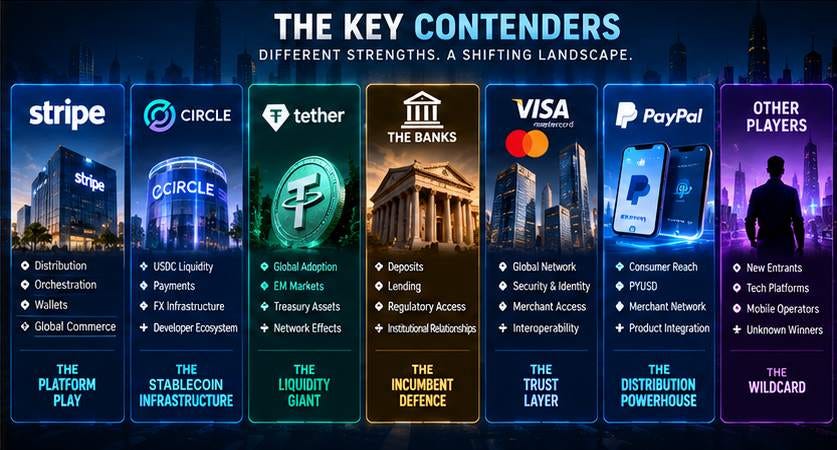
The contest is still unfolding, but the strategic positions are becoming easier to see.
Stripe and Bridge have the potential to become a major orchestration layer, connecting merchants and businesses to stablecoins, wallets, payments and other financial services.
Circle and Tether can provide foundational digital money, benefiting from liquidity, adoption and integrations across the ecosystem.
Visa and Mastercard can extend their global networks into stablecoin settlement, security, compliance and interoperability — provided their services remain valuable as payment methods evolve.
Banks and financial consortiums can use deposits, lending capabilities, regulatory permissions and institutional relationships to defend their position and build new forms of digital money.
PayPal and Ripple bring different combinations of distribution, payments infrastructure, institutional relationships and stablecoin capabilities.
Consumer wallets, technology platforms and mobile operators may hold a different advantage altogether: direct access to users and the ability to make financial services part of everyday digital experiences.
These positions are not mutually exclusive. A bank could use a stablecoin issued by one company, settlement infrastructure provided by another and a wallet built by a third. A consumer could interact with a single application while several providers share the underlying economics.
That is why predicting one outright winner is difficult.
The decisive factors are likely to be distribution, liquidity, trust, regulatory access, user experience and the ability to extend from payments into more valuable financial services.
The companies that control the customer relationship may capture more value than those that provide only one component of the infrastructure. But infrastructure providers can still build highly valuable businesses, particularly when their services become difficult to replace.
The future may not belong to a single company. It may be shaped by a small number of powerful platforms, with different players controlling different layers of the financial stack.
12. The biggest winner may not exist yet
There is one final consideration: we may be looking at the wrong companies altogether.
The next generation of financial giants may emerge from the contenders we see today. Stripe, Circle, Tether, the banks and the global payment networks all have meaningful advantages. But it is equally possible that the ultimate winner is a company that has not yet been founded, built around a business model we have not yet imagined.
We have seen this before. The companies that define a new technological era are not always the ones that dominated the previous one — or even the ones that pioneered the underlying technology. Often, they are the ones that best understand how to bring it to market, distribute it at scale and build lasting relationships with customers.
The infrastructure is evolving, the regulatory landscape is taking shape, and the commercial models are still being tested. We are early in this transition, and there is no guarantee that today's leaders will become tomorrow's winners.
One thing, however, seems increasingly clear: as money and financial services evolve, the battle will not simply be about who processes transactions fastest or operates the most efficient blockchain. It will be about who controls distribution, liquidity, trust and the customer relationship.
The race is not simply to build the rails. It is to control the money, the distribution and the financial relationship that sits on top of them.
And the company that ultimately achieves that may be one we haven't even heard of yet.
Sources
Mastercard: expanded settlement capabilities incl. stablecoins (Jun 2026)
Reuters: Goldman Sachs, BofA and others plan dollar stablecoin for 2027 (Sep 2026)
Follow-up: The Bank Stablecoin Consortium Wave: Strength in Numbers or Death by Committee?
Sound money. Moving money at the speed of sound. — Sonic Money

Founder, Sonic Money · Digital assets & payments · Singapore