The news
The headline. A group of global banks including Goldman Sachs, Citi, Santander and Deutsche Bank has reportedly committed around $270 million to a joint stablecoin venture.
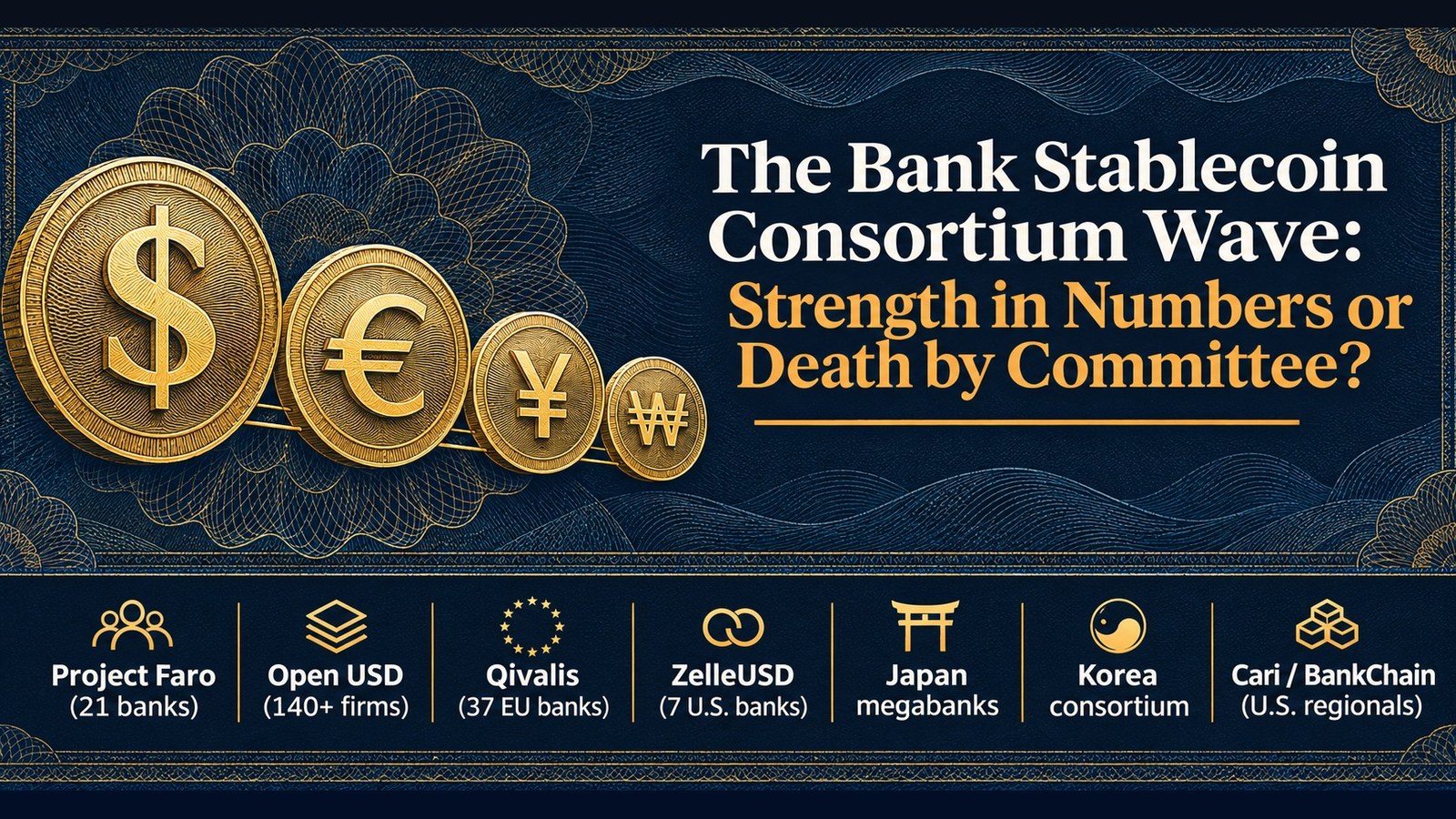
The venture. This is not a new consortium. It was announced on 1 September by 21 banks and asset managers, including Bank of America, Wells Fargo, Fidelity, MUFG, UBS, Lloyds and Standard Bank. It grew out of a 10-bank exploratory group formed in October 2025. It is being reported under the working name Project Faro. The company itself has no formal name yet, has not announced which blockchain it will use, and is still recruiting a CEO.
What the money buys. The $270 million covers five years of operating costs for a US-incorporated issuer. It does not include the reserves backing the coin. The plan is a dollar stablecoin in the first half of 2027, a euro version next, and other G7 currencies after that.
It is the latest of several. In the last 18 months, banks have stopped arguing about whether stablecoins matter and started arguing about how to own them. The answer they keep reaching is the consortium.
The consortia, at a glance
| Initiative | Who | What | Status |
|---|---|---|---|
| Project Faro | 21 global banks and asset managers (Goldman, Citi, BofA, Santander, Deutsche, Wells, MUFG, UBS…) | USD stablecoin, then EUR and G7 | ~$270M committed for 5 years of operating costs; H1 2027 target; CEO search ongoing |
| Open USD (Open Standard) | 140+ firms: BNY, U.S. Bank, Standard Chartered, DBS, Visa, Mastercard, Stripe, Coinbase, BlackRock | USD stablecoin; partners receive reserve income minus a management fee | Launched June 2026; issued by Bridge; reserves at BNY, Lead Bank, BlackRock |
| Qivalis | 37 European banks across 15 countries (ING, UniCredit, BNP Paribas, BBVA, CaixaBank…) | MiCA euro e-money token on public Ethereum | DNB e-money licence granted 14 Oct 2026; issuance expected imminently |
| ZelleUSD (Early Warning) | Bank-owned utility: JPMorgan, BofA, Wells, Capital One, PNC, Truist, U.S. Bank | USD stablecoin for Zelle cross-border, India first | Announced June 2026; India corridor targeted by year-end |
| Japan megabanks | MUFG, SMBC, Mizuho | Jointly issued yen stablecoin under a trust structure | Live transactions targeted by March 2027 |
| Korea bank consortium | KB, Shinhan, Woori, NH, IBK, Suhyup, Citi Korea, SC Korea | Won stablecoin | Waiting on legislation; Bank of Korea wants banks to hold at least 51% of any issuer |
| Cari Network / BankChain Alliance | US regional banks (Huntington, KeyBank, M&T…) and 39 state bankers associations (~3,300 banks) | Tokenized deposits, shared rails, stablecoin capability | Cari MVP March 2026; BankChain targeting 2027 |
The US large-bank tier is split across at least three vehicles, and some banks sit in more than one. Six of Faro's 21 are already committed to a competing bank-led design. JPMorgan has its own tokenized deposit (JPMD) and sits on the Zelle owner's board but not in Faro. That alone tells you this is a hedge as much as a strategy.
Why banks are doing this
1. Deposit defence. Bank of America CEO Brian Moynihan said in January that up to $6 trillion, roughly 30–35% of US commercial bank deposits, could migrate to stablecoins if yield-bearing coins are allowed. Every dollar sitting in USDC is a dollar not funding a loan book. If deposits are going on-chain anyway, banks would rather they move into a bank-controlled token.
2. The float. Circle reported $667.7 million in reserve income in Q2 2026, about 95% of its revenue. That is the economics of a stablecoin issuer: hold T-bills, earn the yield. Banks, payment firms and platforms bring the customers and the volume, and the issuer decides how the interest is split. Circle says it paid about 59 cents of every revenue dollar to distribution partners and transaction costs in H1 2026, but Circle sets those terms. Open USD is built explicitly to reverse that split. Faro and Qivalis keep the float inside the banking system.
3. Neutrality. No bank wants to settle client flows in a competitor's coin. A Citi-issued token will not get adopted by Wells Fargo. A jointly owned issuer is the only structure where rivals can use the same instrument without handing one of them an advantage. This is the same logic behind Visa (originally bank-owned), SWIFT, CLS and Zelle.
4. Regulatory comfort. GENIUS in the US, MiCA in Europe, the Payment Services Act in Japan, and the Bank of Korea's preference for bank-majority issuers all make the bank-led route the path of least resistance. Regulators trust banks to manage reserves, AML and redemption. A consortium of systemically important banks is easier to approve than a startup.
5. Monetary sovereignty. Dollar coins are 99% of the stablecoin market. Outside the US the consortium is partly a policy project. Qivalis, the Japanese megabanks and the Korean banks are all, in part, answers to the question of how not to let local payments run on someone else's currency. I made a related argument about Europe in The World Is Moving On-Chain. The Digital Euro Isn't.
What they are trying to achieve
Stated use cases are consistent across the groups: cross-border payments, 24/7 corporate treasury and liquidity management, settlement of tokenized assets, and eventually retail. Faro names cross-border and digital-asset settlement as its first applications.
Having worked on RLUSD at Ripple, including bank-issued stablecoin and CBDC testing with a commercial bank and the HKMA in Hong Kong, I'd say the honest objective is narrower. The goal is to make sure that when corporate cash moves on-chain, it stays bank money and the bank keeps the client. The motive is defensive. (More on that Hong Kong work in Every Central Bank Wanted to Talk to Us. Then the Public Did.)
Circle's view: why it walked away from the consortium model
Circle is not a neutral commentator here. It also has the most relevant experience.
In 2018, Circle and Coinbase created the Centre Consortium to govern USDC. It was meant to welcome broad industry participation and add more issuers. That never happened. Centre only ever had two members, and its staff fell from more than 20 to single digits. In August 2023 it was dissolved. Coinbase took equity in Circle, and Circle took full control of USDC. The official reason was that regulatory clarity had arrived. Once governments regulate stablecoins directly, a self-governance body is unnecessary.
When Open USD launched in June 2026 and Circle's stock dropped around 16%, Jeremy Allaire went further. He called the track record of consortium products at reaching scale, product-market fit or basic agility "absolutely dismal." His argument has three parts:
Conflicting incentives. Members compete with each other everywhere else, and that carries into the venture.
Slow decisions. Changing chains, fees, partners or product requires agreement among many large organisations.
Underfunding. Members, in his words, tend to "starve the consortium itself on an operating basis." They want the seat at the table more than they want to fund the venture.
Allaire has a commercial interest in saying all this. History still mostly backs him. Libra/Diem lost Visa, Mastercard, PayPal, Stripe and eBay within months and was sold off for under $200 million. we.trade shut down in 2022. Marco Polo went insolvent in 2023. Bank trade-finance and payments consortia have a long record of strong launch announcements followed by no meaningful volume.
Circle restated the case in October on its own blog, in a post by Chief Commercial Officer Kash Razzaghi. It describes USDC as starting in 2018 as a consortium project, with Circle taking full governance in 2023 and rebuilding the model so the issuer could keep investing in the network. It does not name Open USD or Faro, but the target is clear: models that promise partners most of the economics without paying for redemption, compliance and liquidity. Razzaghi says such a model "distributes everything but funds nothing." Circle's own self-reported split for H1 2026: about $1.4 billion revenue, roughly 59% paid to partners and transaction costs, 34% reinvested, and 7% profit. Read that way, Circle's argument is not that sharing economics is wrong. It is that someone has to own the cost base, and committees rarely do.
There is a second, less obvious point in Circle's case. Issuing a token is the easy part. Over several years Circle has built the stack around USDC:
more than 55 licences and registrations
more than 25 partner banks
compliance programmes covering 185 countries
native USDC on more than 35 blockchains
the Circle Payments Network
Arc, its own layer-1, which went to public mainnet on 16 September with BlackRock, Visa, Mastercard and DTCC among the founding validators
USDC is now embedded in exchange, treasury and payment workflows that a new coin has to dislodge one integration at a time. A consortium launching in 2027 is not competing with a token. It is competing with that stack. Notably, Visa, Mastercard and Standard Chartered validate Arc and also back Open USD, which is one more example of the hedging.
Ripple is running the same single-issuer playbook. RLUSD is small next to USDC, at about $2.5 billion against roughly $74 billion. It is also one of the fastest-growing: it started 2026 at about $1.28 billion and is up more than 88% this year while the wider market has been flat. Like Circle, Ripple has built the stack around the token rather than relying on the token alone:
Regulatory perimeter. Ripple National Trust Bank received final OCC approval on 26 October to manage RLUSD reserves, alongside the NYDFS trust company that issues the coin. A Fed master account application is still pending.
Treasury workflow. Ripple bought GTreasury for $1 billion in 2025 and relaunched it as Ripple Treasury. It serves about 1,200 corporate treasury teams, and RLUSD now sits inside the same system CFOs use for bank cash.
Payments and liquidity. Ripple says its payout network covers more than 90% of FX markets and has processed over $95 billion. It also runs a prime brokerage, Ripple Prime (formerly Hidden Road), and lets institutions mint and redeem RLUSD by API through Ripple Mint.
Distribution. Recent listings and integrations include Coinbase and Robinhood, and RLUSD settles card transactions with Mastercard on the XRP Ledger.
Two routes to the same stack. Ripple has largely bought its way in, with about $3 billion of acquisitions in 2024–25:
Hidden Road, now Ripple Prime ($1.25 billion)
GTreasury ($1 billion)
Rail
Metaco
Circle has mostly partnered its way in. It relies on Coinbase, Binance (which invested $100 million in Circle), Visa, Mastercard and Stripe, alongside smaller acquisitions such as Hashnote. The targets differ too. Ripple is going squarely after enterprises and institutions: treasury, prime brokerage, custody and cross-border payouts. Circle is going after both ends: retail and crypto distribution through exchanges and wallets, and institutional settlement through its payments network and Arc.
This is exactly the corporate-treasury use case the bank consortia say they are targeting. Two details are telling. Ripple joined Open USD as a day-one integration partner while still pushing its own coin, so even a competing issuer is hedging. And RLUSD's advisory board includes David Puth, the former CEO of the Centre Consortium. The person who ran USDC's consortium now advises a single-issuer competitor.
Is the consortium model the best way?
My view is that it depends which layer you are building.
Where consortia work: neutral infrastructure. Rails, standards, settlement utilities and messaging (SWIFT, CLS, Zelle, Visa in its early years) are coordination problems. Nobody needs to move fast. Everybody needs to trust that nobody else controls the switch. A shared, regulated issuer of bank-grade digital dollars or euros fits that description. Qivalis, which got its licence and chose public Ethereum, is evidence that a bank consortium can execute when the remit is narrow.
Where consortia struggle: product, and the problem depends on the customer. Most of these consortia start with enterprises. Faro leads with cross-border and digital-asset settlement, Qivalis with corporate payments and treasury, the Japanese megabanks with corporate settlement, and Cari and BankChain with interbank tokenized deposits. Only ZelleUSD starts with consumers. Faro and the Korean group say retail comes later. The two markets break in different places:
Enterprise. Here banks already own the client, which is their real edge. The bottleneck is integration: ERP and treasury systems, verified counterparties on both sides, FX off-ramps, accounting treatment and long sales cycles. A payment only settles if the receiving bank holds the same coin, so splitting across three US vehicles undercuts the network effect. Ripple Treasury and Circle's payments network are already in this lane.
Consumer. Here the fight is liquidity and reach: exchange depth, wallet and DeFi integrations, new chains, merchant acceptance and pricing decisions made in days. This is where committees are slowest and Allaire's critique bites hardest. USDC turns over about 98% of its supply daily and Tether dominates emerging markets. Neither got there by committee. Bank coins also tend to start closed-loop: ZelleUSD launches inside the Zelle app, which protects the customer relationship but caps the network effect.
Net: consortia have a real chance in enterprise, where distribution matters most and speed least. In consumer, they are up against the model they are worst at.
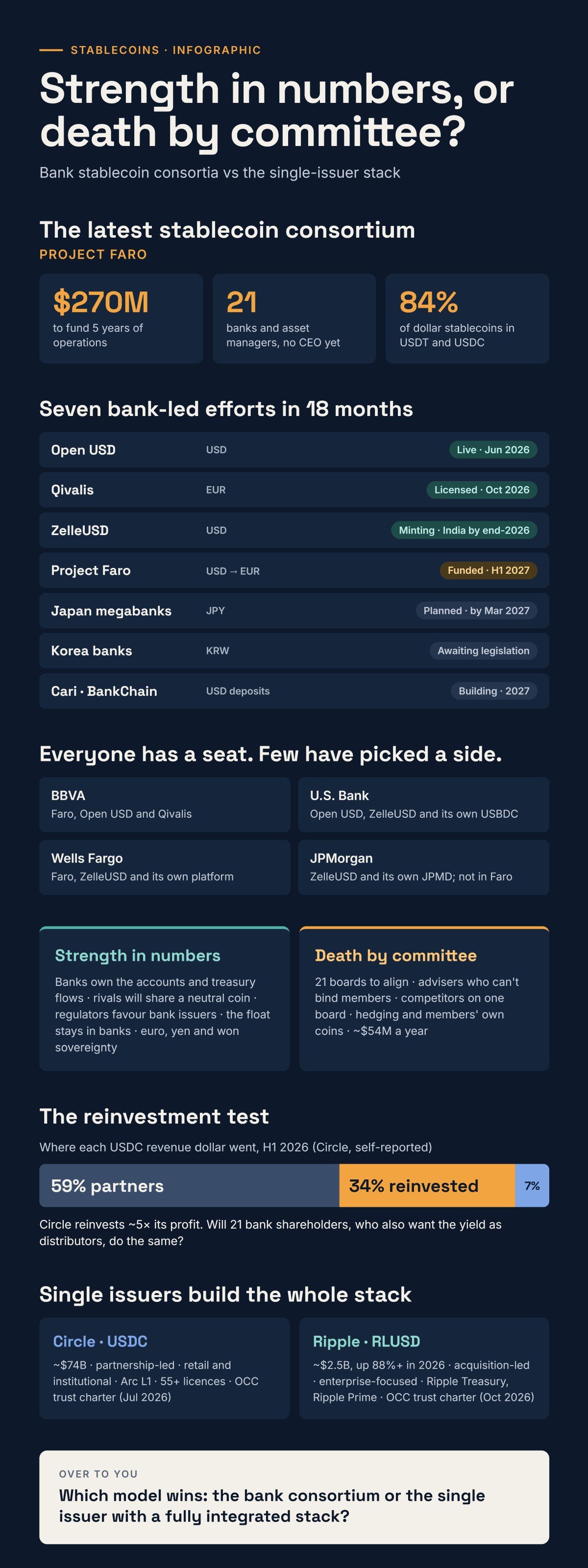
Death by committee, in practice. The structural problems are visible before Faro has shipped anything:
Slow, political decisions. Choosing a chain, a CEO, a fee schedule or a distribution partner means aligning 21 institutions with different regulators, balance sheets and strategies. Two months after announcement there is still no CEO.
Advisers without authority. BCG and Brunswick are advising the venture, but both say they cannot bind the consortium or its members. Management will report to a board of competitors, each with its own priorities.
Built-in conflicts. The members compete with each other in FX, custody, cash management and correspondent banking, which are the exact businesses this coin is supposed to serve.
Hedging. Many members sit in more than one vehicle. BBVA backs Open USD, Qivalis and Faro. Bank of America and Wells Fargo are in Faro and co-own ZelleUSD. U.S. Bank backs Open USD, co-owns ZelleUSD and runs its own USBDC. MUFG is in Faro and the Japanese megabank coin. SMBC and Mizuho back both Open USD and the megabank coin.
Members with their own coins. Fidelity launched its own stablecoin, FIDD, in February and is also in Faro. Wells Fargo is building a proprietary platform alongside the shared networks. JPMorgan has JPMD and stayed out of Faro altogether. If a member already has its own token and rails, the consortium becomes an option it keeps, not the product it pushes.
That last point is the real question for Faro's board: what do members route through the shared coin that they would not route through their own?
The numbers question. $270 million over five years is about $54 million a year. That is a serious budget for a regulated issuer. It is small next to the incumbents' reserve income and next to the liquidity incentives needed to buy market-making depth. It is a test budget, not a war chest. A consortium funded at that level and still without a CEO two months after announcement is exactly what Allaire describes.
The reinvestment test. This is the sharpest version of Allaire's "starve the consortium" point. By Circle's own figures, it reinvests about 34 cents of every revenue dollar and keeps about 7 cents as profit. That means roughly five times as much goes back into licences, banking, liquidity and compliance as is taken out. A single issuer can make that call because the founder controls the cap table and the roadmap. Faro's 21 owners are in a different position. They are also its distributors, and each one has two reasons to pull money out. As shareholders they want a return on the $270 million. As distributors they want as much of the reserve yield as possible passed back to their own balance sheets. Every dollar reinvested in the network is a dollar not returned to a member. Will a board of competitors vote to reinvest five times profit for years? Or will it behave like a traditional shareholder group and push for payouts? Time horizon matters too. Circle has shareholders and a volatile share price of its own, but its investors back one outcome: USDC winning. That lets it play the long game and reinvest ahead of profit. Faro's owners face a double conflict. Most are listed banks reporting quarterly returns to their own shareholders, and the venture is a small line item for each of them, easy to trim when budgets tighten. Open USD has already answered for its partners: nearly all reserve income goes back to them, less a management fee. That is the model Circle says "distributes everything but funds nothing."
The distribution question. This is where I think the banks are underestimating their own hand, and where the consortium model could prove Circle wrong. The core thesis I keep coming back to is that whoever owns the wallet people already use wins. Banks own the accounts, the corporate treasury relationships and the payroll and supplier flows. Circle has to rent distribution through Coinbase, Visa, Stripe and others. Several of those partners are now backing Open USD. If the Faro banks hard-wire their coin into treasury portals, FX desks and correspondent flows, so that the stablecoin is the default rather than an opt-in, they do not need to win on crypto exchanges at all. If they treat it as a side project that each member promotes half-heartedly, it will go the way of every bank consortium before it. I looked at the same distribution question from the payment giants' side in Who Wins When Banks and Payment Giants Lose Control?
The fragmentation risk. Three overlapping US bank vehicles, plus single-bank tokens (JPMD, USBDC), plus tokenized-deposit networks (Cari, TCH, BankChain), is the opposite of the network effect the consortium is supposed to deliver. If corporates have to hold five flavours of bank dollar, the one dollar coin that is accepted everywhere wins by default. That coin is USDC.
Why they are doing it anyway. None of this is stopping the banks, and that tells you more than any single announcement. Banks are afraid of how fast stablecoins have grown and of being left out. Two years ago most of them were lobbying to contain stablecoins. Now there are new bank, network or issuer announcements almost every week, and it is hard to keep up. A consortium seat is the cheapest way to make sure you are not the bank that missed it. The hedging is irrational for any one venture but rational for each bank: own a little of every option until a winner is clear.
And the card networks? Visa and Mastercard have the most to lose in cross-border and merchant settlement, where stablecoins cut out interchange and FX spreads. Their shares fell 19–23% from their highs this year, partly on stablecoin fears and partly on the proposed cap on credit card interest rates. They are not standing still, though. Both are founding backers of Open USD. Visa runs more than 160 stablecoin-linked card programmes and reports about $7 billion of annualised stablecoin settlement. Mastercard is acquiring BVNK and settles real card transactions in RLUSD on the XRP Ledger. Their strategy is to be the layer above every rail: fraud, identity, disputes, tokenisation. They are worried enough to back every horse, not worried enough to give up the merchant relationship.
Bottom line
The consortium is the right legal and regulatory wrapper for banks: it delivers neutrality, regulatory trust and shared cost. It is the wrong operating model for winning a product market unless the members hand real control to a single, well-funded management team and commit their own distribution. Circle left the model because it had the distribution and a single partner and did not need a committee. The banks have the distribution but need the committee, because none of them will use a rival's coin.
The real test for Faro is not the $270 million. It is whether, by end-2027, a Goldman or Citi corporate client can pay a supplier in Faro dollars from their existing banking portal without thinking about it. If that happens, the consortium works. If the coin only lives on a press release and a block explorer, Allaire was right.
Over to you: which model do you think wins, the bank consortium or the single issuer with a fully integrated stack? And if owning the whole stack works, why aren't more payment networks following Ripple and launching their own coin? Join the discussion on LinkedIn.
Further reading
Every Central Bank Wanted to Talk to Us. Then the Public Did.
No Central Bank, No Problem? Lessons from Palau’s Sovereign Stablecoin
Bloomberg: Goldman, Citi Among Banks in $270 Million Stablecoin Backing
American Banker: Open Standard's shared stablecoin goes live
The Block: Ripple gains final OCC approval for its national trust bank
Jason Fullam is a digital assets and payments professional based in Singapore. More at jasonfullam.com.
Digital assets & payments · Singapore