There was a time when it felt like every central bank in the world wanted to talk to us.
This week at Ripple Swell in New York, US Treasury Secretary Scott Bessent argued that regulated, privately issued stablecoins are the answer to government-issued central bank digital currencies (CBDCs).
Having worked on Ripple’s CBDC programme, I’ve seen this story from the other side.
The CBDC gold rush
During my time at Ripple, we were engaging with central banks and governments globally, exploring how blockchain infrastructure could support the next generation of sovereign currencies.
Ripple publicly announced initiatives and pilots involving Bhutan, Palau, Montenegro, Colombia, Hong Kong and Georgia.
The institutional interest was enormous, and the commercial opportunity appeared equally significant.
Imagine a central bank issuing its own digital currency on blockchain infrastructure, with commercial banks participating in distribution, custody and payments.
Every participating institution, wallet and payment could potentially generate activity on the network.
We thought we were building the foundations of a very substantial business.
But then something changed.

The public trust problem
The technology wasn’t necessarily the problem. Much of the work demonstrated that blockchain infrastructure could support these use cases.
The bigger challenge was public perception and politics.
CBDCs gradually became a dirty word, particularly in Western markets. Concerns around financial privacy, government surveillance and programmable money entered the mainstream conversation.
Could governments restrict what you spend your money on? Could your access to funds be switched off? Could money come with conditions attached to how, when or where it could be spent?
Fears about programmable money, whether real or exaggerated, became the story.
Even where proposed CBDC designs included privacy protections and safeguards, overcoming that public distrust became a significant challenge.
And perception matters enormously when you’re trying to introduce a new form of national currency.
The question nobody could ignore: what happens to commercial banks?
There was another dimension to the CBDC debate that deserves more attention.
Blockchain-based digital money introduced the possibility of moving value directly between individuals and businesses, without necessarily relying on traditional banking intermediaries.
For commercial banks, this raised a much bigger question than simply modernising payments.
If people could hold digital currencies in independent wallets and transact peer-to-peer, what would happen to the traditional banking model? Would banks risk losing their role as custodians of deposits and intermediaries in the movement of money?
Central banks generally weren’t looking to become retail banking operators. They didn’t necessarily want to onboard millions of customers, manage wallets, handle customer service or build consumer payment applications.
They needed commercial banks to do that.
So we ended up exploring models where the central bank issued the underlying digital currency, but commercial banks handled distribution, wallets and the customer relationship.
This blurred the lines between a central bank digital currency and a regulated, bank-distributed digital currency.
It raised a fundamental question: were we really creating an entirely new form of money, or simply moving the existing financial architecture onto new rails?
I also began questioning whether, in an increasingly digital economy, central banks needed to be the direct issuers of the digital money consumers and businesses use every day. In many markets, perhaps that role is better served by regulated private institutions, with central banks providing the sovereign monetary foundation and settlement infrastructure.
The shift towards stablecoins
This is where the commercial proposition started to look very different.
Ripple subsequently launched its own stablecoin, RLUSD, in December 2024. I was involved in the broader work around evaluating the economics and stablecoin landscape, and it represented a significant evolution.
Rather than convincing a central bank to issue an entirely new form of sovereign money, a private company could issue a regulated digital currency backed by traditional reserves.
You could build distribution through exchanges, payment companies, financial institutions and corporate customers.
You still needed regulatory approval, compliance, banking relationships and robust reserve management. But you weren’t dependent on a government deciding to launch an entirely new monetary instrument.
The route to commercial adoption was fundamentally different.
Hong Kong: seeing the transition first-hand
This is where the story becomes particularly personal for me.
I ran the Hong Kong CBDC project with a commercial bank and the Hong Kong Monetary Authority (HKMA), seeing first-hand how central banks and financial institutions were exploring the possibilities of digital sovereign money.
Fast forward to today, and Hong Kong is demonstrating a different direction.
Following its e-HKD pilot programme, the HKMA concluded that its immediate priority should be wholesale applications, including tokenised asset settlement and cross-border payments, rather than retail use cases.
One finding particularly caught my attention: the public perceived e-HKD and tokenised deposits similarly, largely because of the high level of trust in Hong Kong’s existing banking system.
In other words, consumers weren’t necessarily concerned about whether their digital money was issued by the central bank or represented a tokenised commercial bank deposit. The experience and trust in the institution mattered more.
Then, on 23 October, HSBC launched RedCoin, its regulated Hong Kong dollar stablecoin, through PayMe, making it available to more than 3.3 million users.
Think about that transition.
A market where I had previously seen central banks exploring the future of digital currency is now putting privately issued, regulated stablecoins directly into consumers’ hands.
This is precisely the direction Scott Bessent is advocating.
So where do I think CBDCs actually belong?
I don’t believe both models need to compete for the same use cases.
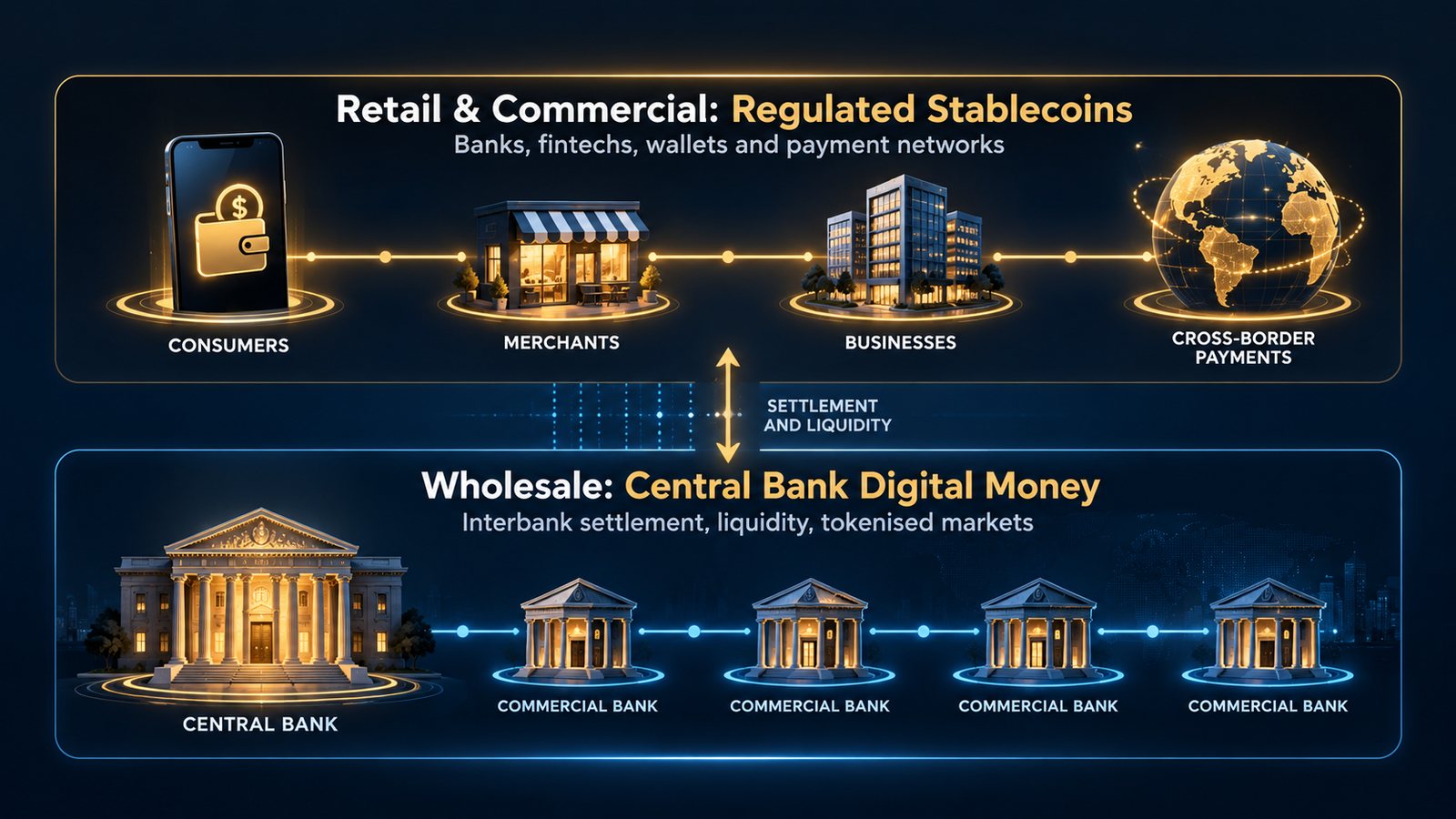
In my opinion, the strongest argument for CBDCs is in wholesale financial infrastructure.
Think about banks settling transactions with one another, managing liquidity and moving money between financial institutions, potentially outside traditional banking hours.
As tokenised assets and financial instruments move towards 24/7 markets, the ability to settle those transactions in central bank money becomes increasingly important.
This is where wholesale CBDCs can make a lot of sense.
It’s largely invisible to the retail and commercial customer. They don’t need to interact with a central bank digital wallet or think about the monetary infrastructure sitting behind their payments.
The central bank continues to provide the trusted settlement asset, while financial institutions and technology providers build the infrastructure around it.
Retail and commercial digital money is a different proposition.
Here, I believe regulated private-sector stablecoins have the advantage. They offer a natural route to adoption through existing banks, fintechs, payment companies, exchanges and mobile wallets.
They also create commercial incentives for businesses to invest in distribution, integrations and new payment experiences, without putting central banks directly in the middle of the relationship between governments and the general public when it comes to everyday money.
The UAE: a market pursuing both
The UAE is taking a different path from both the US and Hong Kong.
It is rolling out the Digital Dirham, a CBDC with legal tender status, for retail and wholesale use, while also licensing private-sector dirham payment token issuers.
Rather than choosing one model, it is letting both coexist under one regulator.
That makes it one of the most important markets to watch: it will show where sovereign digital money and private stablecoins each find their natural role.
Is Scott Bessent right?
Broadly, I believe he is.
Privately issued, regulated stablecoins are well positioned to become the dominant model for retail digital money and increasingly important in commercial payments and cross-border transactions.
Wholesale CBDCs have a genuine role in the future of financial market infrastructure.
But we shouldn’t confuse the two.
We spent years helping central banks explore the future of digital money. One of the biggest lessons for me is that building the technology was never the hardest part.
Building trust, achieving regulatory alignment and getting distribution right were always going to matter just as much.
Perhaps the future of digital money was never about putting a central bank digital currency in everyone’s pocket.
Perhaps it was about building better financial infrastructure behind the scenes, while allowing regulated private companies to innovate on the money people actually use.
Have retail CBDCs had their moment, with private stablecoins now taking the lead?
Further reading
Jason Fullam is a digital assets and payments professional based in Singapore. More at jasonfullam.com.

Digital assets & payments · Singapore