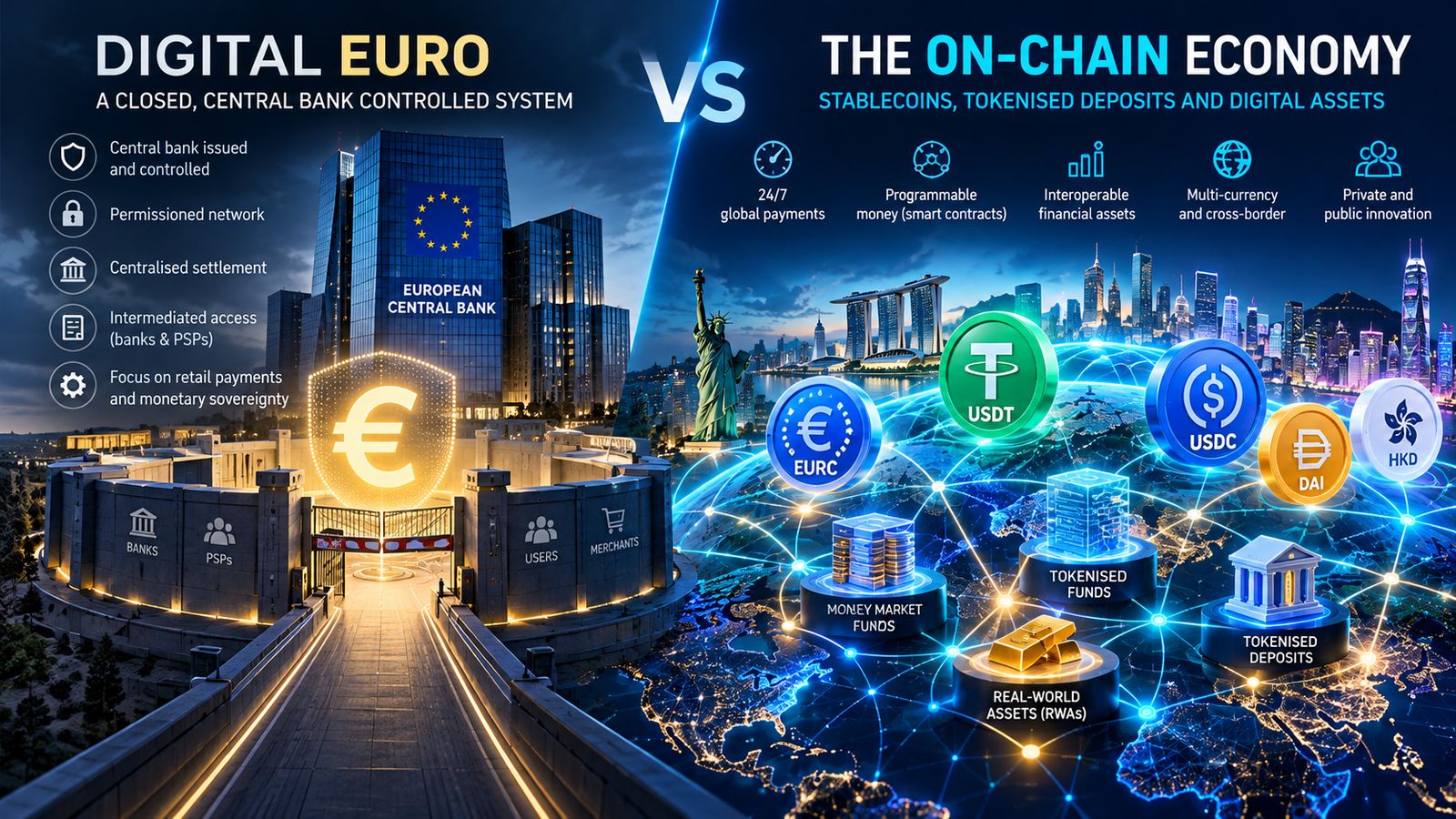
In the space of a few days, two developments showed how differently major economies are approaching the future of money.
At Ripple Swell in New York, US Treasury Secretary Scott Bessent spoke about the role of stablecoins in strengthening US dollar dominance.
In Hong Kong, HSBC launched RedCoin, its HKD-denominated stablecoin, bringing tokenised money directly into its PayMe app, with more than 3.3 million potential users.
And then there’s Europe.
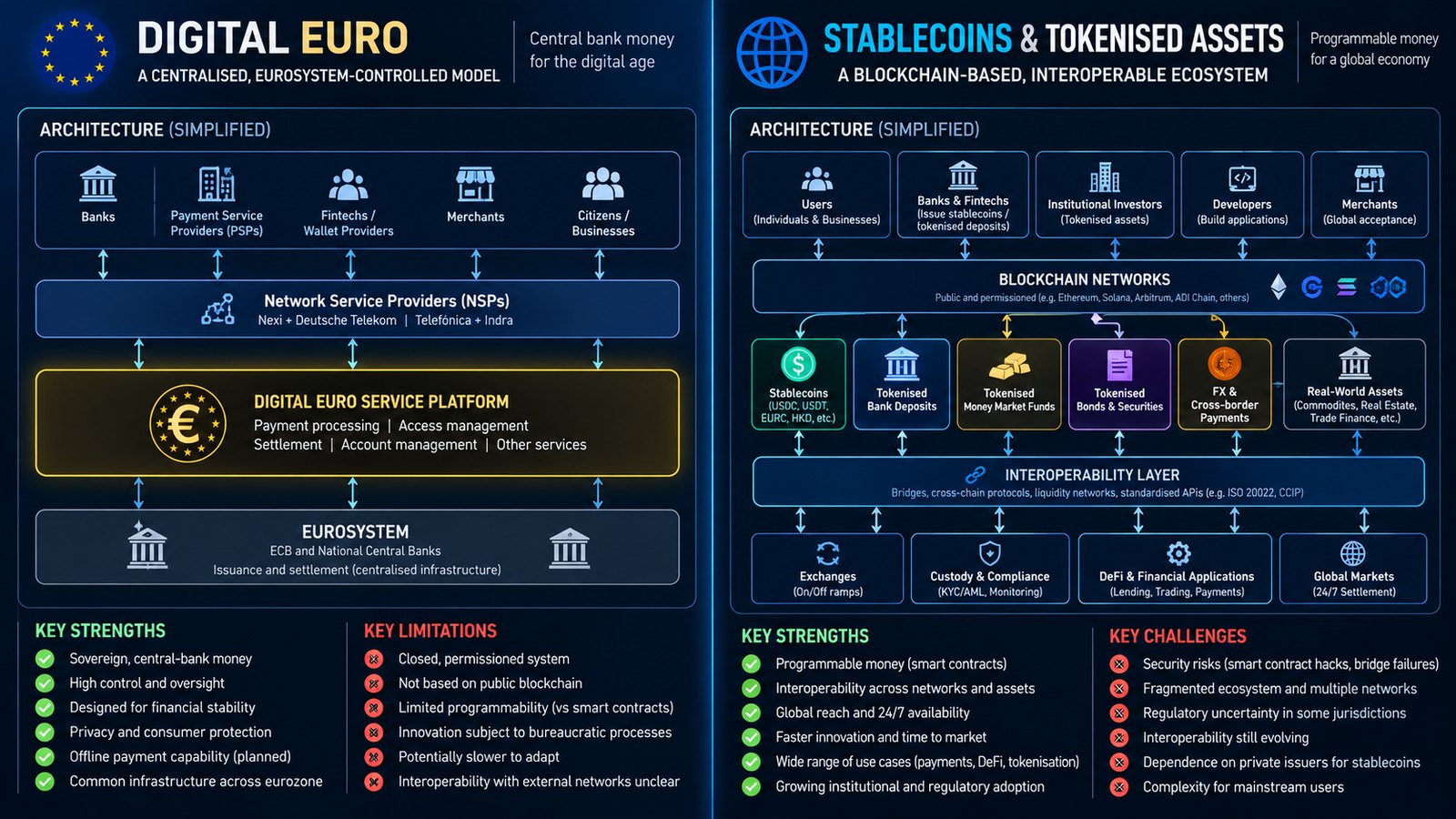
The ECB has just selected the network service providers for the digital euro: Nexi with Deutsche Telekom, and Telefónica with Indra’s Minsait.
What stands out isn’t the decision to build a digital euro. It’s the architecture and the philosophy behind it.
The retail digital euro will run on a centralised settlement platform controlled by the Eurosystem, with private providers supplying the connectivity around it. And the timeline is long: a pilot could start in 2027, with a first issuance possible in 2029, if the legislation is adopted.
RedCoin is live today.
There are legitimate reasons for Europe’s approach. Monetary sovereignty, financial stability, privacy, security and the need for a risk-free form of public digital money all matter.
But it raises a bigger question: are we building the financial infrastructure of tomorrow on the architecture of yesterday?
Two different visions of digital money
Europe’s approach is essentially about bringing central bank money into the digital age.
Hong Kong’s approach is increasingly about enabling an ecosystem of regulated stablecoins, tokenised deposits and tokenised financial instruments.
Take HSBC RedCoin. Its initial use cases are straightforward:
Peer-to-peer payments.
Payments to merchants.
Integration into existing banking and payment apps.
The bigger story is what comes next. HSBC plans to let customers subscribe to tokenised investment products using RedCoin, starting with a share class of its HKD money market fund, and to expand into wholesale corporate and institutional use cases.
At that point money is no longer just a means of payment. It becomes the settlement asset for a tokenised financial system.
Imagine moving seamlessly between:
Stablecoins and tokenised bank deposits.
Money market funds and tokenised bonds.
Digital currencies and foreign exchange.
Corporate treasury and cross-border payments.
All on infrastructure that supports programmable transactions, atomic settlement and 24/7 availability. That is a much bigger opportunity than digitising payments.
Interoperability is the real challenge
There is a problem we shouldn’t overlook.
We are heading towards a fragmented landscape of blockchains, stablecoins, tokenised deposits and proprietary networks. A stablecoin on one network doesn’t automatically move to another. A tokenised deposit issued by one bank may be confined to its own permissioned ecosystem.
We risk recreating the silos that traditional financial infrastructure has spent decades trying to remove.
I saw this first-hand at Ripple, working with On-Demand Liquidity, which used on-chain FX routing to move value between currencies. The lesson was that the ledger is rarely the hard part. Liquidity, conversion and settlement at each end of the transaction are what make cross-border money actually move.
The breakthrough won’t come from having hundreds of digital currencies. It will come from making them interoperable, with reliable conversion, liquidity and settlement finality between networks, institutions and instruments.
That is where common standards, secure interoperability protocols and trusted settlement infrastructure become critical.
But is blockchain always the answer?
I don’t think we should dismiss the ECB’s concerns.
Public blockchain networks bring genuine challenges around cybersecurity, smart contract vulnerabilities, governance, privacy and regulatory oversight. There have been substantial losses from compromised protocols, bridges and wallets. These are not trivial considerations for sovereign money and critical financial infrastructure.
To be fair, the ECB isn’t ignoring distributed ledgers either. Its Pontes project is designed to connect DLT platforms to central bank settlement, so tokenised transactions can settle in central bank money, and its longer-term Appia work looks at an integrated tokenised ecosystem for Europe.
So the question is why the retail layer is taking such a different path.
Blockchain doesn’t have to mean giving up security or regulatory control. Permissioned networks, audited smart contracts and institutional-grade custody can deliver controlled environments while keeping the benefits of distributed ledgers and programmability.
The test should be which architecture delivers the best combination of security, resilience, interoperability and functionality, not whether centralised or decentralised infrastructure is inherently superior.
Where does this leave us?
I suspect the future monetary system will combine public and private money: tokenised deposits, regulated stablecoins and central bank settlement infrastructure.
These models don’t need to compete. They need to work together.
Hong Kong is a market to watch because it is bringing banks, technology providers and digital asset businesses into the same regulated ecosystem, and putting the results in consumers’ hands now.
Europe has different priorities, and the digital euro may well deliver on its objectives. But I question whether a largely closed, centrally controlled retail architecture will provide the flexibility and interoperability global finance needs as it moves towards tokenisation.
The next generation of financial infrastructure won’t be defined by who issues the digital currency. It will be defined by how easily money moves between currencies, networks and financial instruments.
The winners will be those who make that movement seamless.
Further reading
The Bank Stablecoin Consortium Wave: Strength in Numbers or Death by Committee?
Every Central Bank Wanted to Talk to Us. Then the Public Did.
ECB: dual-track strategy for DLT settlement in central bank money (Pontes and Appia)
Jason Fullam is a digital assets and payments professional based in Singapore. More at jasonfullam.com.

Digital assets & payments · Singapore