
A note before you read: I'm not a CISO. I've spent 20 years in payments and digital assets, most recently at Ripple, working with banks, central banks and regulators on stablecoins and tokenisation. This piece is a strategic observation from that seat, written from the perspective of the security leaders I've worked alongside, and an open invitation to the established cybersecurity vendors to take a closer look at this market. I want to see institutions move on-chain safely, and quickly.
On 29 October, attackers drained approximately $6.3 billion from Binance's wallets across ten blockchains, most of it in around 20 minutes. It is the largest crypto theft on record, roughly four times the size of the Bybit attack in February 2025. The FBI has attributed it to TraderTraitor, the North Korean group behind the Bybit attack.
Five days later, CrowdStrike opened its Fal.Con Europe conference by announcing an AI Kill Switch for its Falcon platform. It lets security teams terminate a rogue AI agent where it runs, block it from relaunching and cut off its network access. On the same day, CrowdStrike agreed to acquire two specialist AI security businesses: Fiddler AI for agent observability and Dreadnode for automated security testing.
Agentic AI is barely in production at most enterprises. CrowdStrike is already building the controls for it.
One industry is losing billions to attacks that start in ordinary corporate IT. The other is securing a threat surface most of its customers have only just started to deploy.
Put yourself in the CISO's chair
Imagine you are the CISO of a global bank. Your business is launching tokenised deposits, a stablecoin settlement service or a digital custody offering.
You already have a security stack you trust. CrowdStrike is on every endpoint. Palo Alto Networks or Fortinet secure your network. Mandiant is on call for incident response. These relationships took years to build. The vendors have been through your procurement, risk and regulatory reviews. They understand your environment, your SOC and your board.
Then digital assets arrive, and you are told you need a new set of vendors.
The specialists in on-chain security, such as Hypernative, Blockaid and Forta, are good at what they do. They provide real-time monitoring, threat detection and transaction screening across blockchain networks. But compared with the vendors already inside the bank, they are young and small, with limited track records at institutional scale.
So the CISO is left with an uncomfortable choice. Keep the trusted platform for everything except the part of the business that may soon move the most value. Or bring in a startup, put it through procurement and stitch it into a security operation it was never designed for.
This isn't a criticism of the specialists. Many are doing impressive work on the on-chain layer. The difference is scope and experience: the established vendors have spent two decades protecting the full attack surface, from endpoints and identities to networks and cloud, while the specialists have focused on the blockchain itself.
The obvious question is: why can't I use my existing cybersecurity provider when I move on-chain?
The attack started where the incumbents already operate
On 3 November, Binance published its initial findings. The attack began in September, when a software engineer was approached on a job-hunting platform, taken through a series of fake interviews and asked to download a coding "assignment" onto a company laptop. It contained zero-day malware which, in Binance's words, "was not detected by the endpoint security protection tools at the time."
Over the following weeks, the attackers used that laptop and an internal AI tool to reach other engineers' machines, including one holding a container deployment token. On 29 October they used Binance's internal wallet-signing service to take control of a hot wallet. Binance says the investigation is ongoing and subject to independent review.
The important detail is where this began: not with a smart-contract exploit or a flaw in a blockchain protocol, but with a recruitment scam, an employee device and stolen credentials, inside corporate infrastructure.
That is exactly the territory established cybersecurity providers protect every day. Social engineering and state-sponsored groups such as North Korea's are a core part of their threat intelligence business.
It also shows that endpoint protection on its own is not enough. Even good tools can miss a zero-day. What matters is what happens next: whether a compromised laptop can quietly become a path to the systems that move billions.
The breach became a blockchain problem at the very end, when the signing service was abused. By then the money was already gone.
Two security worlds that don't talk to each other
This is the real gap. It isn't that blockchain specialists lack capability, or that enterprise platforms can secure a wallet out of the box. It is that the two sit in separate worlds.
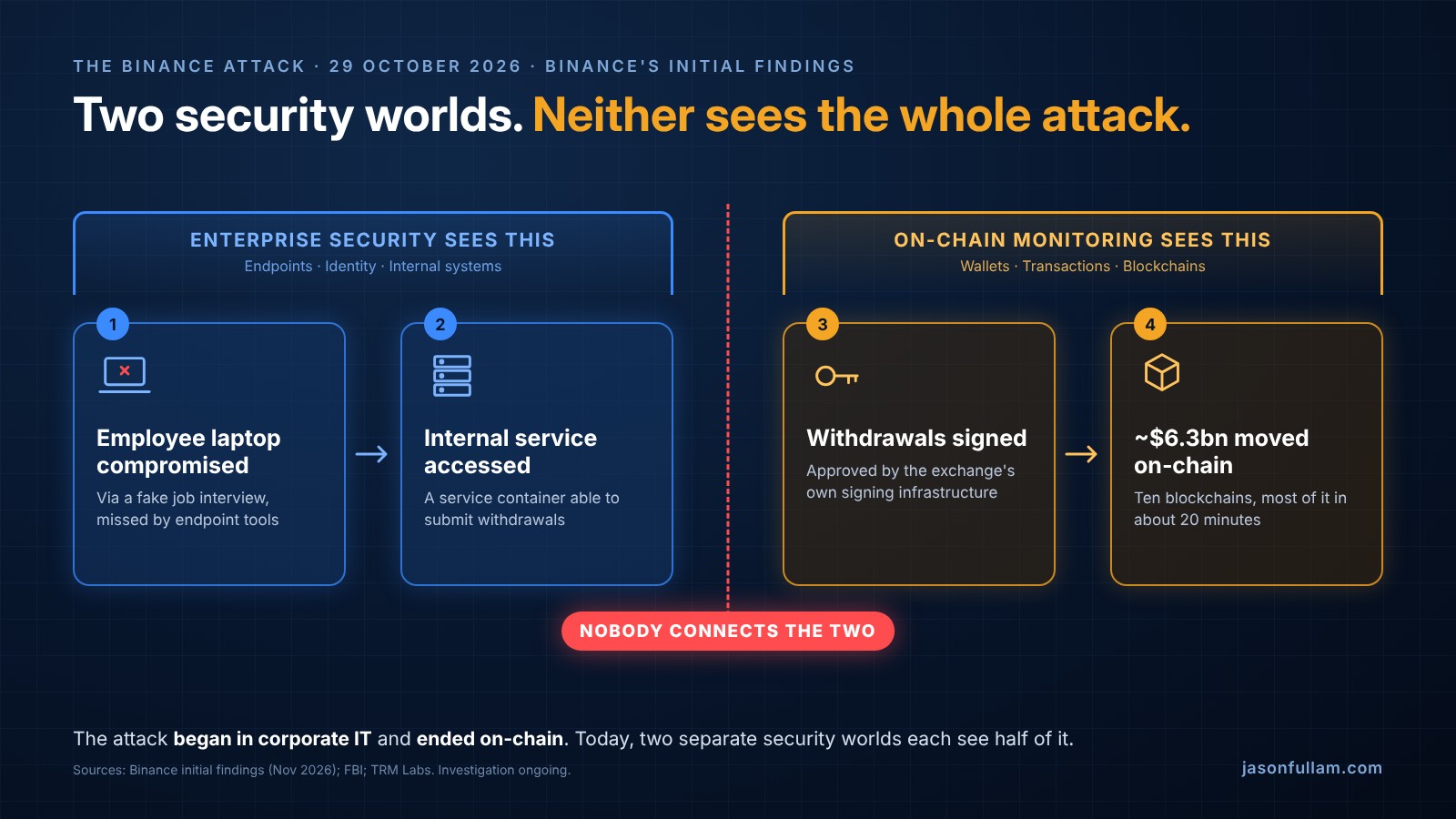
At best, the enterprise platform sees the compromised laptop, the unusual login and the lateral movement. The on-chain monitor sees the abnormal withdrawal. Neither sees the full chain of events, and nobody connects them in time.
Now imagine one coordinated security framework:
A compromised endpoint is automatically linked to the wallet services that device can reach.
An unusual signing request triggers the same incident response as any other critical alert.
Privileged access to transaction systems is revoked the moment an identity is flagged.
That is what enterprise security platforms are built to deliver. It is what institutions will expect as digital assets move from pilots into production.
The stakes are rising
Institutional adoption is no longer experimental. Banks are issuing tokenised deposits and stablecoins. Asset managers are bringing funds on-chain. Payment providers are settling cross-border flows in stablecoins. Treasury teams are holding digital assets on balance sheet.
As more value moves on-chain, the security standard has to match the rest of the bank. That means the same governance, the same operational resilience and the same incident response, ideally from the same trusted partners.
Today, a CISO cannot get that from a single vendor.
Will the incumbents move in?
CrowdStrike's announcements show how established cybersecurity companies enter new categories. They don't wait for the market to mature. They buy specialist expertise and fold it into the platform their customers already use.
There is no obvious reason the same playbook couldn't work for digital assets. Buying a blockchain security specialist would give an enterprise provider on-chain threat intelligence, transaction monitoring and scarce engineering talent overnight. It would also give the specialist the enterprise distribution, resources and credibility that would otherwise take years to build.
Blockchain-native expertise will remain essential. Cryptographic keys, transaction signing and irreversible settlement are genuinely different problems. But that expertise may be more valuable inside a platform the bank already trusts than as another standalone vendor.
We've seen this before
Earlier in my career I sold cloud and enterprise infrastructure at Rackspace, Verizon and Orange Business. When cloud computing first arrived, enterprises told us they would never put their core applications in it. Security was the objection we heard most.
A decade later, those same core applications run in the cloud. What changed wasn't only the technology. A security industry grew up around it, and enterprises got controls they could trust from vendors they already knew.
On-chain finance is at the same point today. Security is one of the bottlenecks, and it is solvable. I'd rather we didn't wait another ten years for institutional on-chain finance to go mainstream.
An open invitation
The Binance attack will be studied for years. One lesson may be uncomfortable for the industry: the tools protecting digital assets have not kept pace with the value they are now asked to protect.
The companies best equipped to close that gap are already inside every major bank. They have the relationships, the resources, the threat intelligence and the reputation.
To the teams at CrowdStrike, Palo Alto Networks, Fortinet and Google Cloud's Mandiant: the institutions you already protect are moving value on-chain. Most of them would rather extend a relationship they trust than start a new one. The opportunity is there. I'd welcome the conversation.
Until then, every CISO moving on-chain will keep asking the same question.
Further reading
Every Central Bank Wanted to Talk to Us. Then the Public Did.
The Mortgage of the Future: When Real Estate Becomes a Programmable Asset
Help Net Security: Fake job interview opened the door to $6.34 billion Binance heist
Jason Fullam is a digital assets and payments professional based in Singapore. More at jasonfullam.com.

Digital assets & payments · Singapore