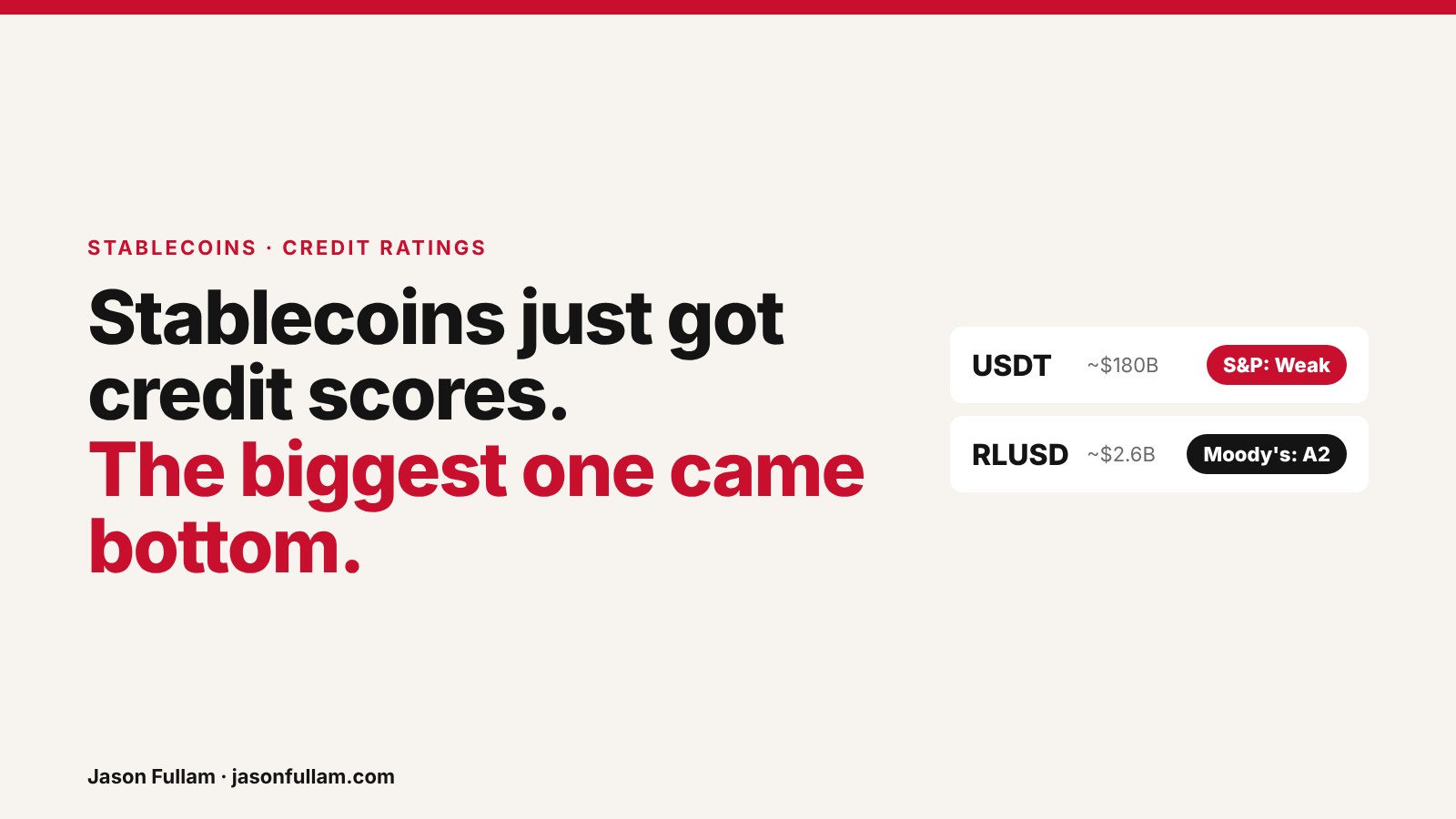
In October, Moody's gave Ripple's stablecoin RLUSD an A2 rating, the first time it has given a stablecoin an investment-grade grade. A year earlier, S&P cut Tether's USDT, by far the largest stablecoin, to the bottom of its stablecoin scale. Stablecoins now have credit scores, and the biggest one came bottom. Most people I speak to aren't sure what any of this means. Here it is in plain English.
What a credit rating actually is
A credit rating answers one question: if I hold this, how likely am I to get my money back, in full and on time? Ratings are for promises to pay you back, like a company's bonds rather than its shares. A stablecoin is exactly that kind of promise: give me a dollar now, and I'll give you a dollar back.
The grades are letters, like a school report. Aaa is the best; the further down the alphabet, the riskier. The line that matters is investment grade: above it, most banks, funds and corporate treasuries are allowed to hold an asset. Below it is "junk". For a stablecoin, the agency mostly rates the reserves behind it, and whether holders can actually get to them.
Where RLUSD sits, next to names you know
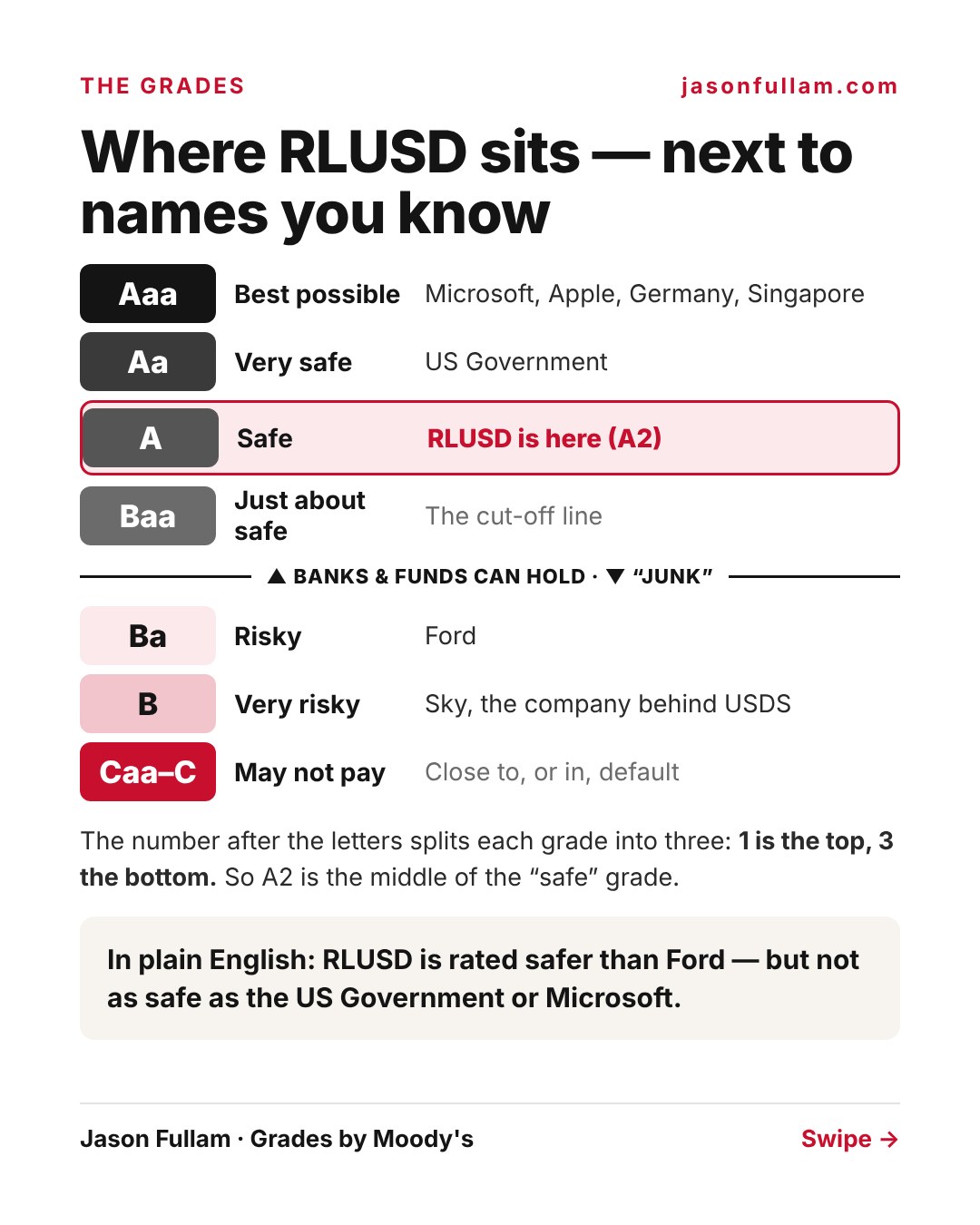
The number after the letters splits each grade into three: 1 is the top, 3 the bottom. So A2 is the middle of the "safe" grade. In plain English, RLUSD is rated safer than Ford's debt, but not as safe as the US Government or Microsoft.
Why A2 and not higher? The reserves are strong: mostly US Treasury bills and cash, kept at BNY, kept separate from Ripple's own money, and targeting $1.03 for every $1 coin issued. What held it back is that holders don't yet have a direct legal claim on the reserves, so their protection if the issuer went bust is weaker. Moody's path to an upgrade is to give holders a priority claim. The full Moody's credit opinion is available with a sign-in.
S&P asks a different question
S&P's best-known stablecoin product is different. Its Stablecoin Stability Assessment, running since December 2023, is a 1 to 5 score for one question: will this coin hold its $1 peg, especially under stress? It is not a credit rating, and S&P picks the coins itself rather than being paid by issuers for it. Moody's rates coins whose issuers apply and pay.
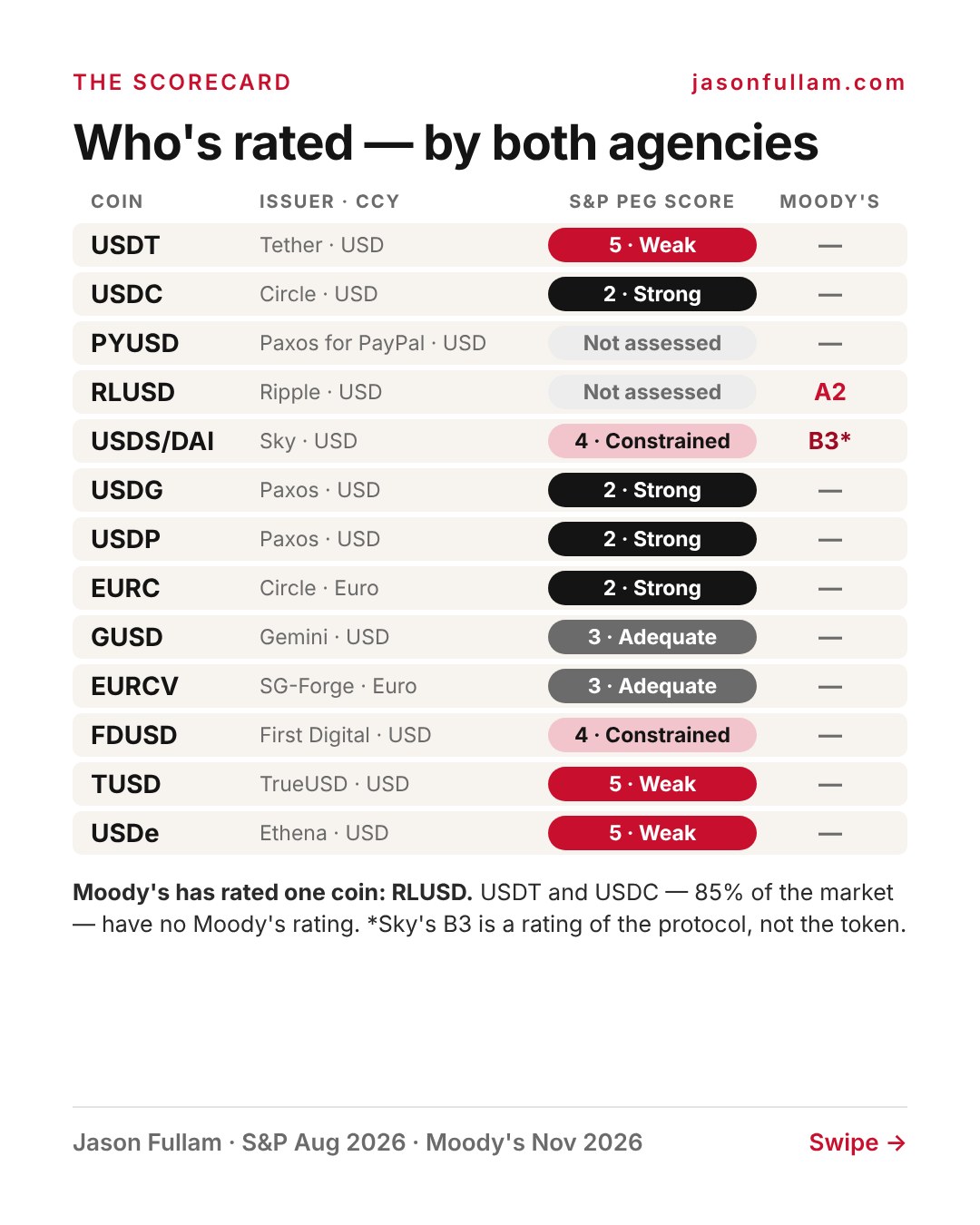
Two things stand out. Moody's has rated exactly one stablecoin, RLUSD; USDT and USDC, about 85% of the market, have no Moody's rating. And PYUSD isn't on S&P's list at all, even though Paxos, which issues it, has two other coins scored "strong". No rating doesn't mean bad. It means not assessed.
Why the biggest stablecoin scores "weak"
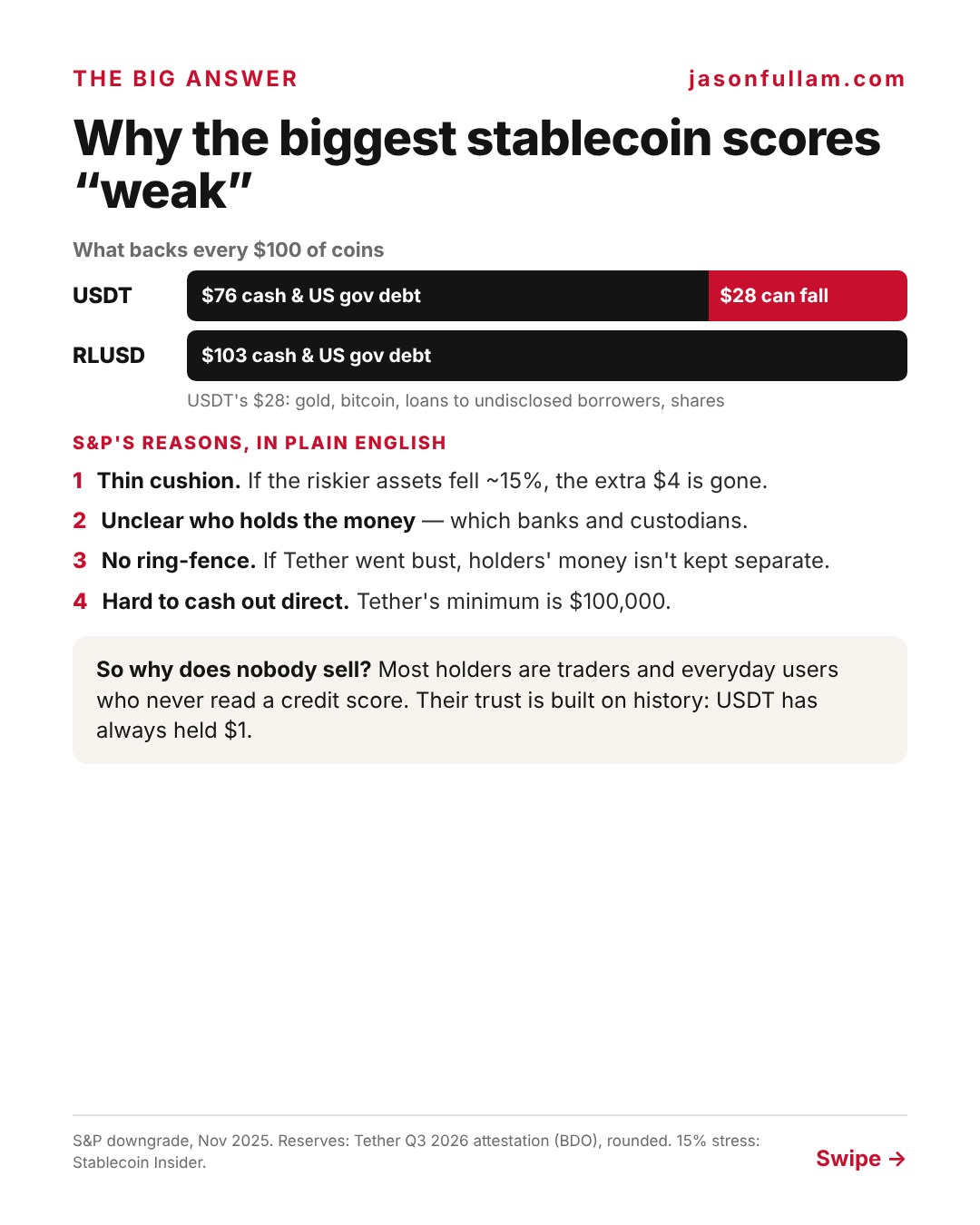
For every $100 of USDT, Tether holds about $104. About $76 of that is cash and US government debt. The other $28 is gold, bitcoin, loans to undisclosed borrowers and shares, all of which can fall in value. If those fell by roughly 15%, the extra $4 would be gone. RLUSD holds about $103 for every $100, all in cash and US government debt.
When S&P cut USDT to 5 in November 2025, it gave four reasons: riskier assets had grown to 24% of reserves, with bitcoin alone larger than the safety cushion; it is unclear which banks and custodians hold the money; holders' money isn't kept separate from Tether's own if Tether went bust; and most holders can't cash out with Tether directly, because the minimum is $100,000.
So why does nobody sell? Most holders are traders and everyday users who never read a credit score. Their trust is built on history: USDT has always held $1, and for many of them the alternative is a falling local currency.
Is this the new safety authority?
Partly. A rating adds an independent outside view, on a scale banks already use, that checks both the reserves and the legal structure. But coverage is patchy, and a rating doesn't test the code that runs the coin. That is why S&P bought OpenZeppelin, the smart-contract security firm, in September. And rating agencies have been wrong before. Treat a rating as one of four checks: a licensed issuer, monthly reserve reports, an independent rating, and a record of paying out redemptions.
Where the rating does the work
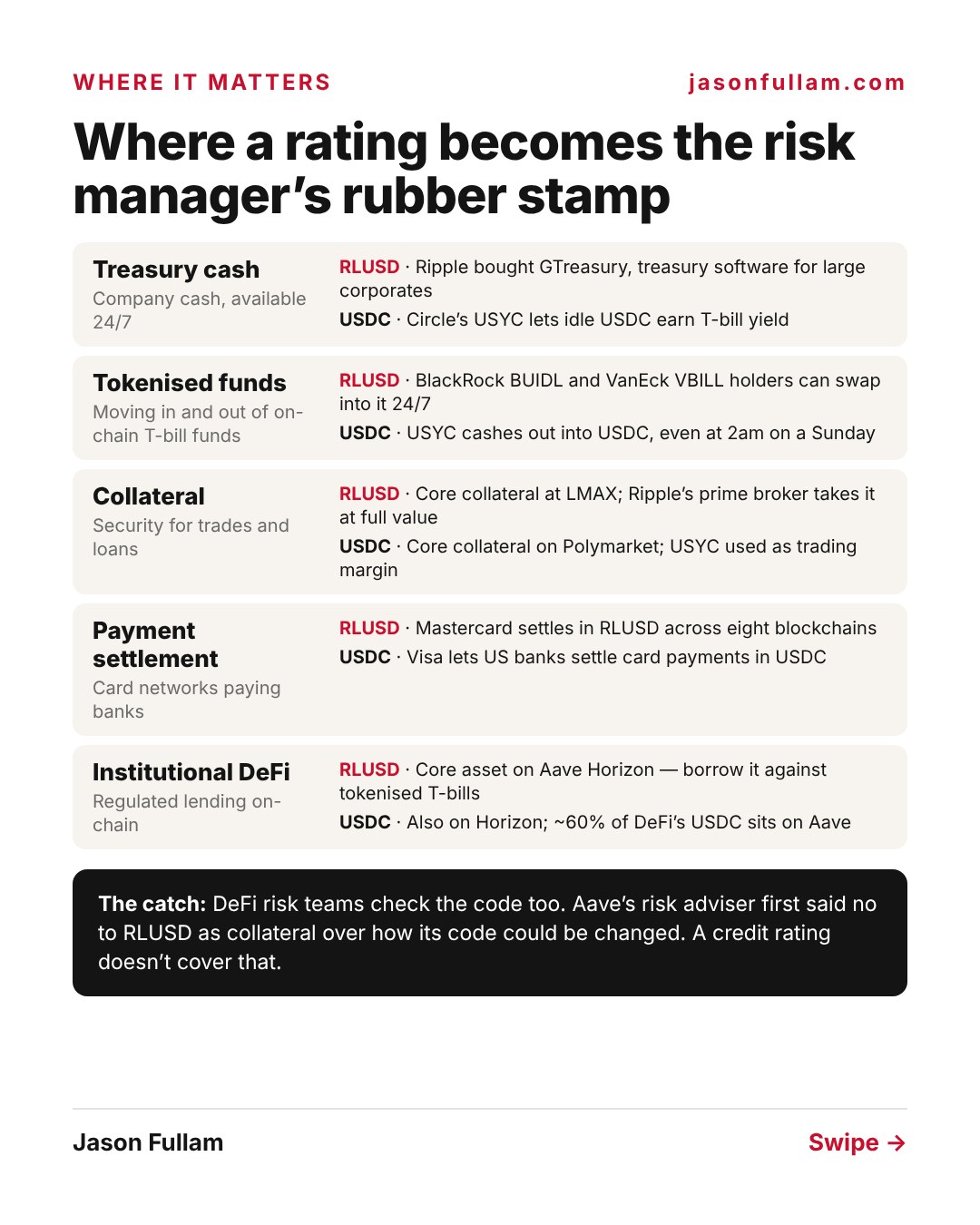
Ratings are built for institutions. Retail users don't check them, but treasury teams, banks and funds do, and many can only hold what is rated safe. That is where RLUSD and USDC are competing: company treasury cash, moving in and out of tokenised Treasury funds such as BlackRock's BUIDL, collateral for trading and loans, card settlement with Mastercard and Visa, and regulated on-chain lending on Aave Horizon.
There is a catch. DeFi risk teams check the code too. In October 2025, Aave's risk adviser LlamaRisk advised against using RLUSD as collateral on Aave's main market because its contract could be upgraded without a delay. A credit rating doesn't cover that.
What happens next
Ripple is lining RLUSD up for corporate treasury in a big way, and a Moody's grade is the ticket in. I expect others to follow as the market matures, and not just dollar coins. Euro, yen, Singapore dollar and dirham coins will want a grade too, if their reserves are ring-fenced. The rules are pushing the same way: in the US, accounting standard-setter FASB is consulting until 19 November on when a stablecoin can count as a cash equivalent, and its tests look a lot like what Moody's checks.
Would your treasury hold an unrated stablecoin?
Sources
Moody's rating action and credit opinion on RLUSD (October 2026); S&P Global Ratings Stablecoin Stability Assessments update (August 2026) and USDT assessment (November 2025); Tether Q3 2026 attestation by BDO; Moody's US sovereign action (May 2025); S&P Global's acquisition of OpenZeppelin (September 2026); Aave governance forum, LlamaRisk review of RLUSD (October 2025); FASB proposed update on cash equivalents (August 2026). Not investment advice.
Further reading
99.3% of Stablecoins Are Dollars. Will On-Chain Ever Look Like the Fiat World?
The Bank Stablecoin Consortium Wave: Strength in Numbers or Death by Committee?
Every Central Bank Wanted to Talk to Us. Then the Public Did.
No Central Bank, No Problem? Lessons from Palau’s Sovereign Stablecoin
Jason Fullam is a digital assets and payments professional based in Singapore. More at jasonfullam.com.
Digital assets & payments · Singapore