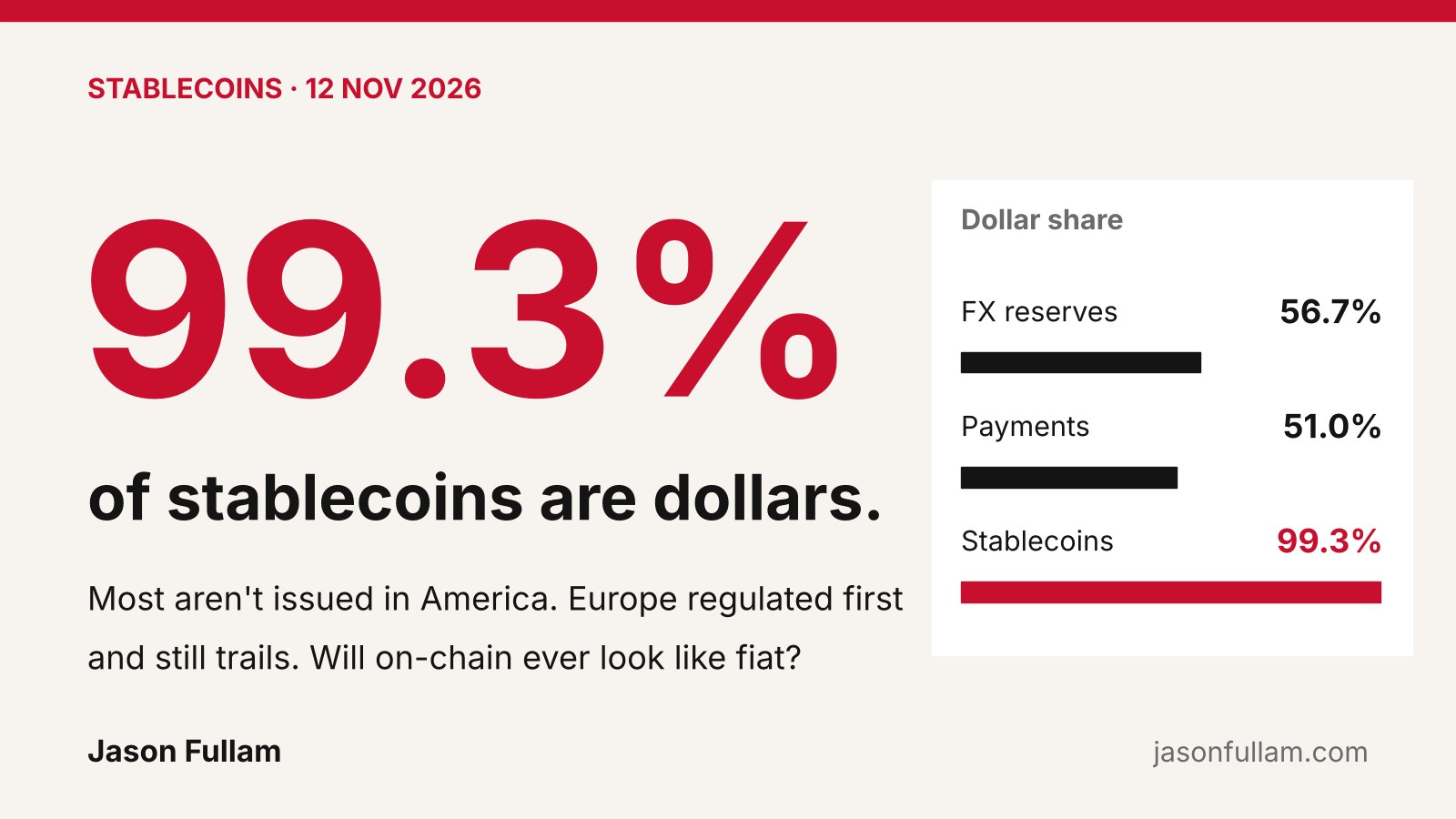
For years the story has been de-dollarisation: central banks diversifying reserves, the yuan pushing into trade settlement, Europe building its own payment rails. On-chain the story runs the other way. Stablecoins have made dollars easier to get than at any point in history, and almost every one of them is a dollar.
Today: the dollar is 99.3% of all stablecoins
As of 12 November 2026, dollar stablecoins total $289.1 billion. Every other currency combined is about $2.0 billion. The euro is the largest of the rest at $843 million, followed by the Russian ruble ($571 million), the UAE dirham ($233 million), the Japanese yen ($148 million) and the Brazilian real ($69 million). Everything else is below $50 million.
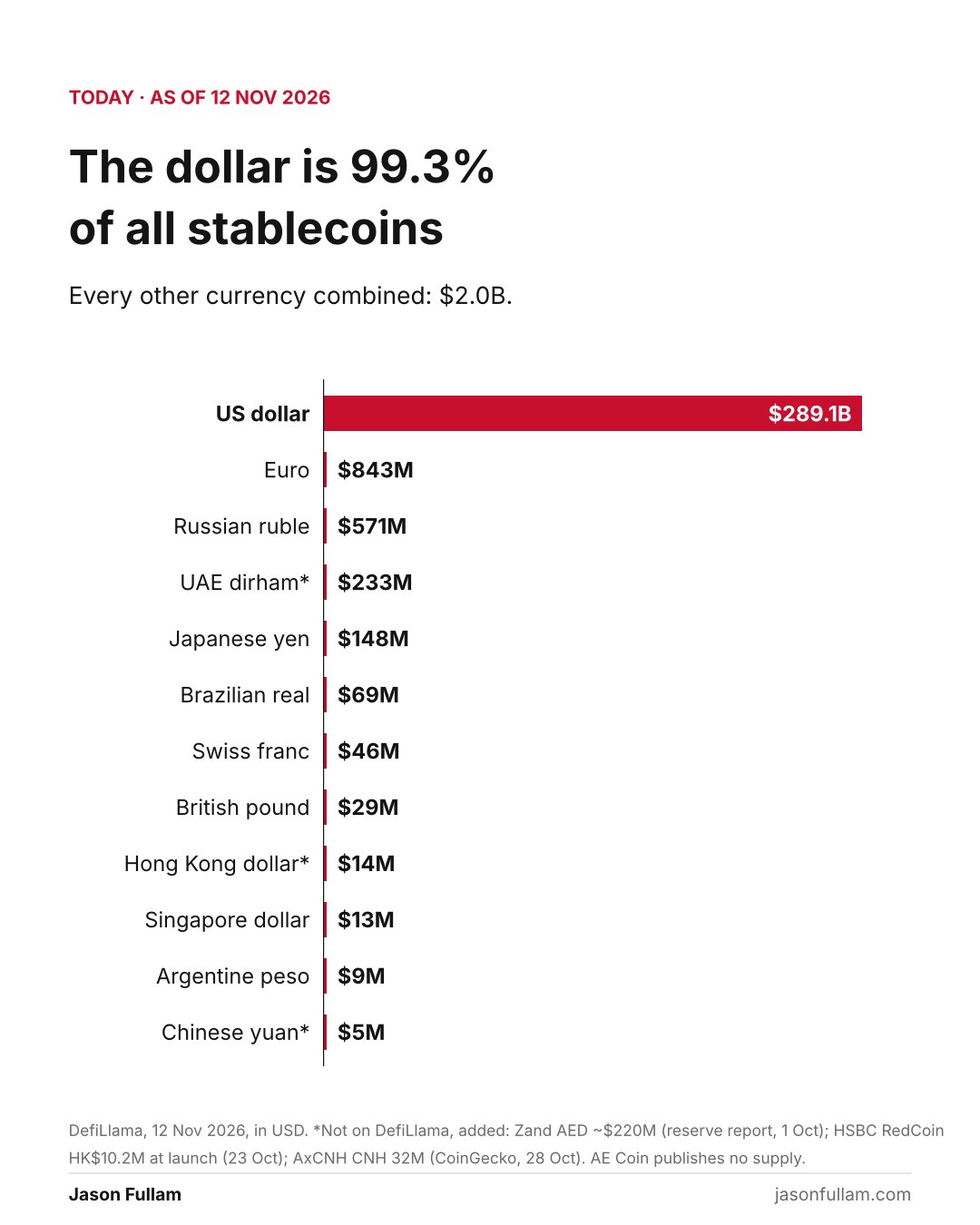
A note on the data: most figures come from DefiLlama. Three coins it doesn't track are added from issuer and market data: Zand's AED stablecoin (AED 806 million, reserve report of 1 October), HSBC's RedCoin (HK$10.2 million at launch on 23 October) and the offshore-yuan AxCNH (CNH 32 million, 28 October).
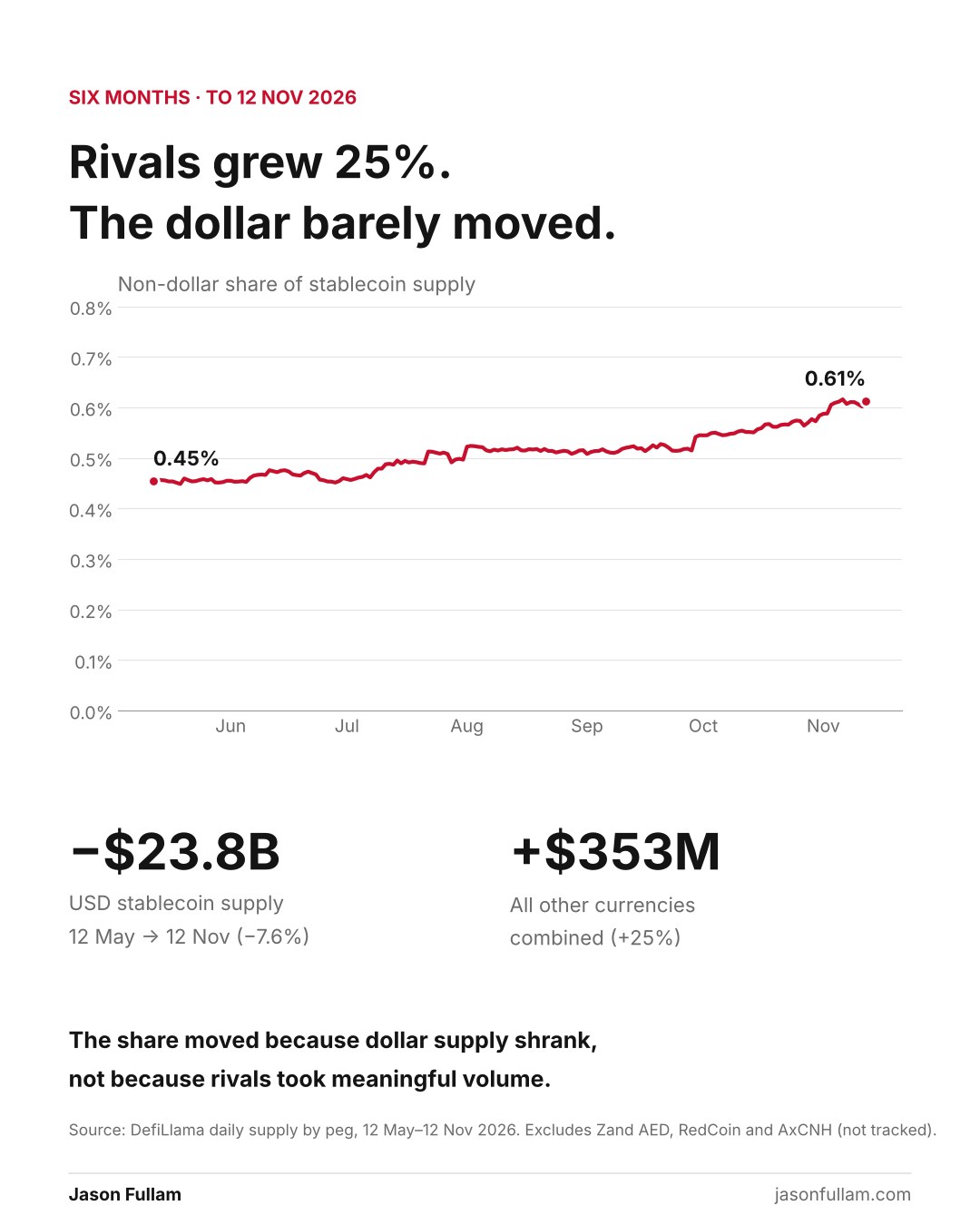
Six months: rivals grew 25%, the dollar barely moved
Between 12 May and 12 November, the non-dollar share of stablecoins rose from 0.45% to 0.61%. That looks like progress. It isn't, really. Dollar stablecoin supply fell by $23.8 billion (−7.6%) over the period, while all other currencies combined added $353 million. The share moved because dollar supply shrank, not because rivals took meaningful volume.
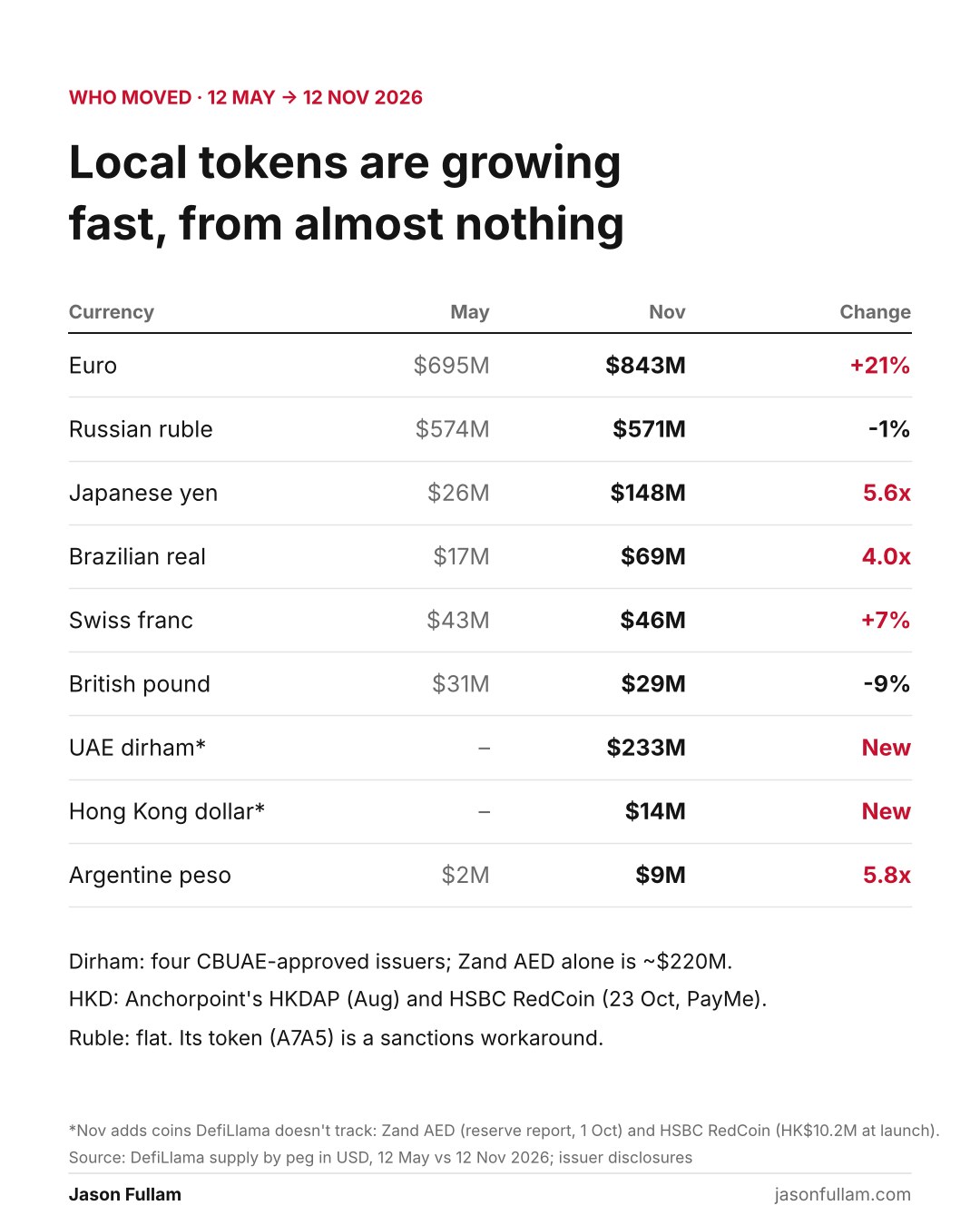
Some local tokens are growing fast, from almost nothing. Yen stablecoins are up 5.6x, the Brazilian real 4.0x and the Argentine peso 5.8x. Euro coins grew 21%. The dirham and Hong Kong dollar are effectively new: the UAE has four CBUAE-approved dirham issuers, and Hong Kong has Anchorpoint's HKDAP (August) and HSBC's RedCoin (October). The ruble was flat; its token, A7A5, is a sanctions workaround rather than a market.
Who issues dollar stablecoins: one offshore giant, then a wall of US issuers
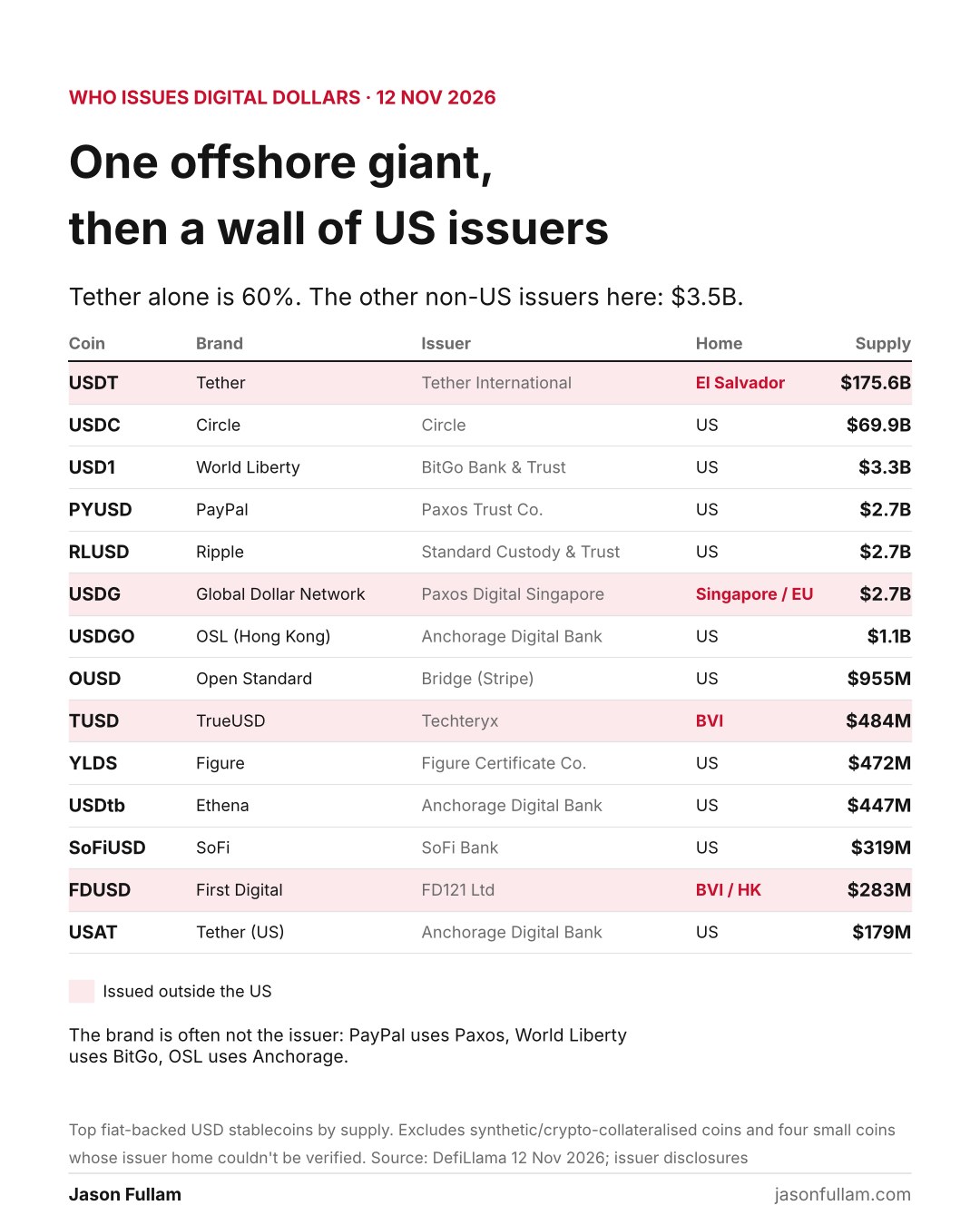
The dollar dominates on-chain, but the largest issuer of on-chain dollars isn't American. Tether's USDT, at $175.6 billion, is about 60% of all dollar stablecoins, and it is issued from El Salvador. Circle's USDC ($69.9 billion) is a distant second. Below that, the top 14 fiat-backed dollar coins are mostly issued by US trust companies and banks: BitGo (USD1), Paxos (PYUSD), Standard Custody (RLUSD), Anchorage (USDGO, USDtb, USAT), Bridge (OUSD), Figure (YLDS) and SoFi Bank (SoFiUSD).
Outside Tether, the non-US issuers in the top 14 add up to only about $3.5 billion: Paxos Digital Singapore's USDG (Singapore and EU), Techteryx's TUSD (BVI) and First Digital's FDUSD (BVI and Hong Kong). The brand is often not the issuer: PayPal uses Paxos, World Liberty uses BitGo and OSL uses Anchorage.
Regulation isn't the deciding factor
A common argument is that on-chain volume follows whoever leads on regulation. Europe is the counter-example. It regulated first, and the dollar still dominates.
MiCA came first (December 2024). USDT was pushed off EU exchanges, and Circle's EURC went from about 17% to about 58% of euro stablecoins. But euro coins total only $843 million. The rules picked the winner within the euro market; they didn't make the market big.
The GENIUS Act was signed in July 2025. Since then the OCC has approved trust charters for Circle, Ripple, Paxos and BitGo, and banks such as SoFi now issue dollar stablecoins. Dollar stablecoins grew from $254.9 billion at signing to $289.1 billion today.
Tether went offshore for the rules. It moved from the BVI to El Salvador and never applied for MiCA. Under GENIUS, USDT's US access after July 2028 depends on a Treasury ruling, so Tether launched USAT, issued in the US by Anchorage.
The reserves still go to Washington. Tether held $132.4 billion of US Treasury bills at the end of Q3. Treasury Secretary Bessent has described dollar stablecoins as an important source of funding for the Treasury. Wherever the issuer sits, the dollar system collects the reserves.
Regulation decides who can issue, where, and to whom. It hasn't decided which currency people want to hold.
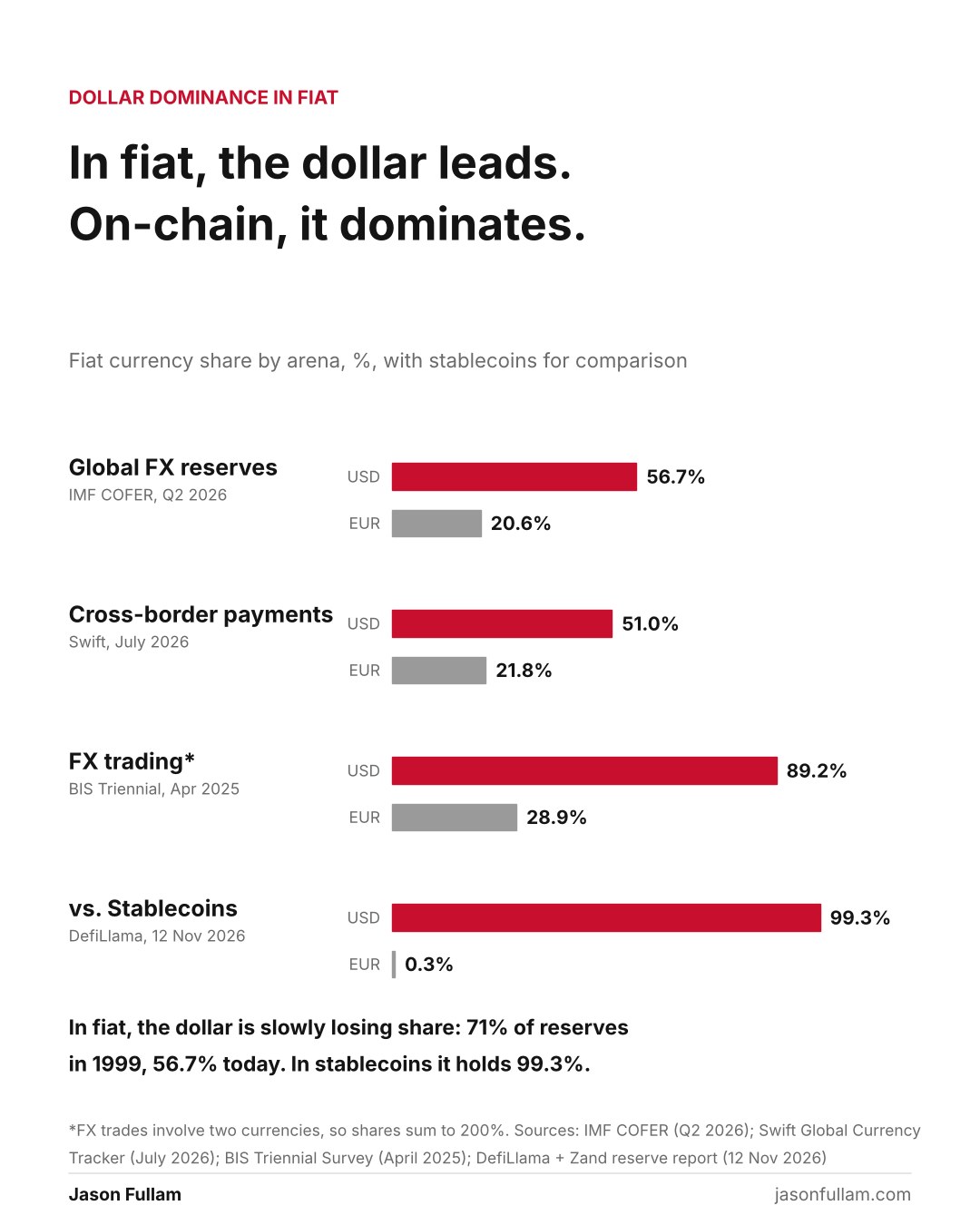
In fiat, the dollar leads. On-chain, it dominates.
Put the stablecoin numbers next to the fiat world and the gap is stark. The dollar is 56.7% of global FX reserves (IMF COFER, Q2 2026) and about 51% of cross-border payments by value (Swift, July 2026). It is on one side of 89% of FX trades (BIS Triennial Survey, April 2025). In stablecoins it is 99.3%. The euro is 20.6% of reserves and about 22% of payments, but 0.29% of stablecoins.
Will stablecoins ever mirror the fiat world?
It is early. Many of the significant local launches happened only this year: SBI's yen coin JPYSC went live in June, the Qivalis bank consortium got its Dutch e-money licence in October, and RedCoin launched in October. Even so, the distance is large.
| Currency | Share of FX reserves | Share of stablecoins | What's happening |
|---|---|---|---|
| Euro | 20.6% | 0.29% | MiCA pushed USDT off EU exchanges. Qivalis licensed in October 2026. Revolut's euro stablecoin is live. |
| Yen | 5.0% | 0.05% | SBI's JPYSC live since June. The MUFG, SMBC and Mizuho coin is due by March 2027. |
| Yuan | 2.0% | 0.002% | Offshore AxCNH is live. The offshore CNH pool is only about 0.27% of China's money supply. |
Also worth watching: the Korean won, where an eight-bank consortium is waiting on legislation, and sterling, where UK banks have chosen tokenised deposits over stablecoins. I covered the bank-led efforts in The Bank Stablecoin Consortium Wave.
The euro holds a fifth of world reserves. On-chain it holds less than a third of 1%.
Maybe on-chain never looks like fiat
Fiat currency shares reflect decades of trade, reserve management and policy. Stablecoin shares reflect something simpler: what people choose to hold when they can hold anything. A phone in Lagos, Buenos Aires or Istanbul can now hold, send, save and borrow in a currency that isn't its own. Given that choice, people pick dollars.
That raises a question the de-dollarisation debate hasn't fully absorbed. As more of finance moves on-chain, does the mix drift toward fiat's, with the euro, yen and yuan taking a share closer to their weight in reserves? Or does the dollar keep its 99.3% for good, and the on-chain economy end up more dollarised than the one it replaces? I've made a related argument about Europe in The World Is Moving On-Chain. The Digital Euro Isn't.
Where do you land? Join the discussion on LinkedIn.
Sources and method
Stablecoin supply: DefiLlama daily supply by peg, 12 May to 12 November 2026, in USD; plus Zand AED (reserve report, 1 October), HSBC RedCoin (launch, 23 October) and AxCNH (CoinGecko, 28 October). CNHT is excluded. Issuer table: fiat-backed dollar coins only; synthetic and crypto-collateralised coins excluded. Fiat comparisons: IMF COFER (Q2 2026; yuan Q1), Swift Global Currency Tracker (July 2026), BIS Triennial Survey (April 2025; FX shares sum to 200%).
Further reading
The Bank Stablecoin Consortium Wave: Strength in Numbers or Death by Committee?
No Central Bank, No Problem? Lessons from Palau’s Sovereign Stablecoin
Every Central Bank Wanted to Talk to Us. Then the Public Did.
Jason Fullam is a digital assets and payments professional based in Singapore. More at jasonfullam.com.

Digital assets & payments · Singapore